
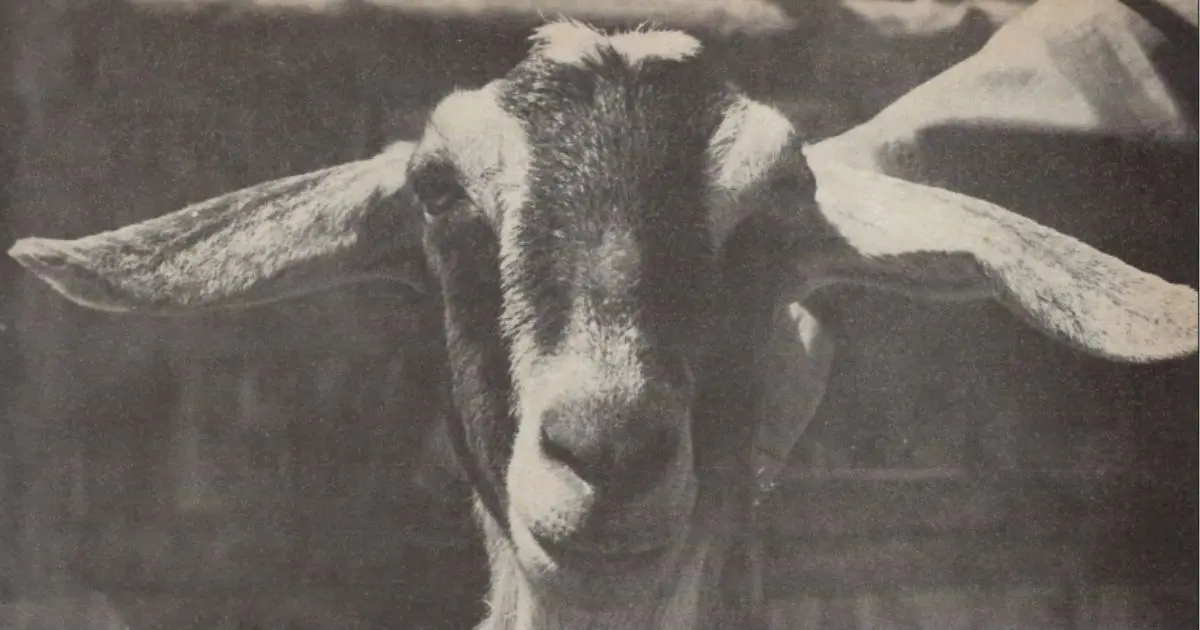
The goat is an animal of the recession, according to some economic observers who have figures to show that the goat population in North America rises perceptibly in hard times. Others say that a recent 25 percent jump in purebred goat registrations in a single year is more than indicator of the country’s economic doldrums. Resourceful, easy to handle (mature does weigh less than 135 lbs.) and inexpensive to buy and feed, the goat is a near-perfect animal for the small farmstead.
With neither elaborate housing nor expensive equipment, a country family can expect to be kept in milk for 10 months of the year by only two does, and during the spring milk “flush” that follows their return to pasture, the dairy goats will produce enough to allow for some simple – almost foolproof – cheese making.
“I think there is a terrific future in goats,” says Michael Draper, a 31-year-old farmer who keeps some 50 Saanan dairy goats on his farm near Roblin, Ontario. “They can survive and produce in areas where other domestic animals cannot perform… in jungles, deserts and rocky mountain terrain. It may seem strange to us in North America, but it is a fact that 60 per cent of the milk consumed in the world is goat’s milk. And the staple meat for most of the cultures in the world is goat meat. Goats, like giraffes, prefer to eat what they find at eye-level. They will eat grass, but if there is anything green on a tree or bush nearby, they will consume that first.
In their browsing they will even eat such apparently bitter evergreens as cedar and juniper. “Goats will actually do better on browse than on grass,” says Draper. “Trees have considerably deeper roots than grass, and as a result there is a higher of level of minerals in leaves on trees than there is in grass. I think it may be higher in total digestible nutrients as well.”
Goats seem to have lost fewer of their natural habits than other domesticated animals, which may explain why goat keepers report few health problems among their charges. Goats may get lice and most have some intestinal worms, but both types of parasites are easily treated and little cause for concern among healthy goats.
One common skin infection is known as Goat Pox, which is concentrated around the hairless areas near the udder. It will clear up within four weeks if untreated, and it usually does not affect the same goat twice in her life.
Domestication has not erased one important element of a goat herd in the wild, and the animals still have a distinct breeding season, whereas cows and swine, for example, will breed any time during the year. The doe will come into heat during the early fall, often in September, in her first year of life. Healthy, well-grown kids can be bred at the age of seven or eight months, but many goat herdsmen prefer to wait until they are 18 months old (when they are called goatlings) to prevent any chance of stunting.
In some cases it is difficult to detect the heat period, especially if there is but one goat on the premises. The doe will bleat more often than usual, and her vulva will usually be swollen slightly. Other signs of estrus include uneasiness, frequent urination and tail shaking.
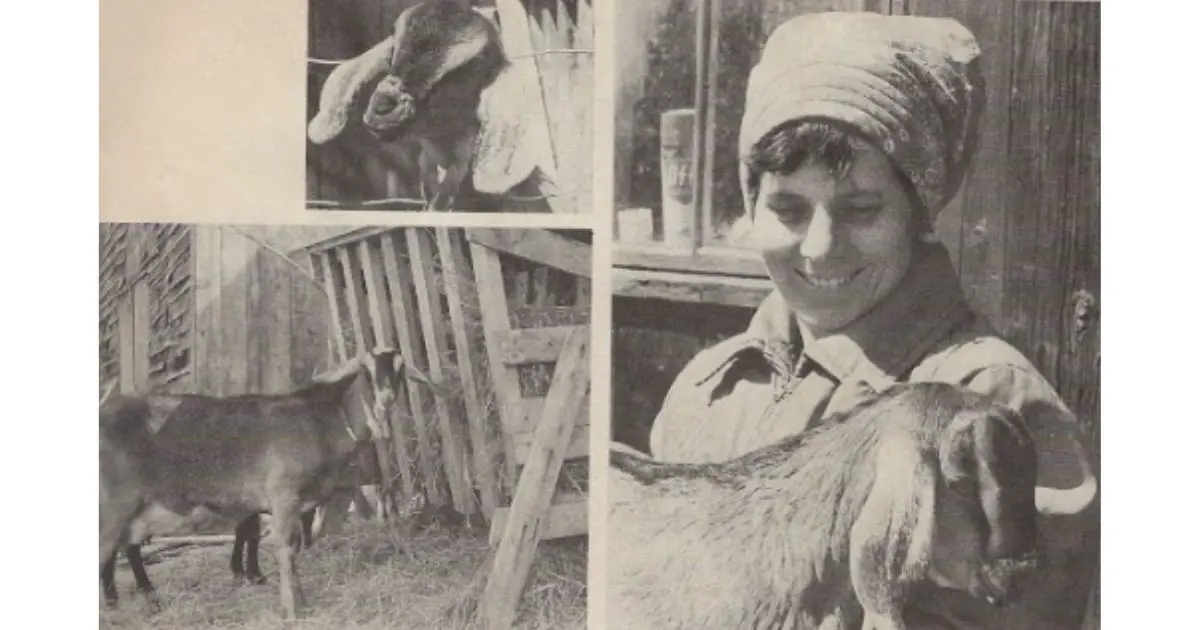
Most small-time goatherds don’t own a buck themselves, but take the doc-in-season to visit someone else’s billy for a modest fee. The heat will only last two or three days, and the second day is usually chosen for the service. If the owner is unable to get his doe bred in time, or if the mating has failed, the goat will come back in heat every 19 to 21 days after her first heat period. She will repeat this cycle until early January or until she becomes pregnant.
The gestation period is 151 days, plus or minus three, and so most does will accomplish their “kidding” or “freshening” in the late winter or early spring. Twins are the rule, rather than the exception, and triplets are quite common. In some breeds, notably the Nubians, even quadruplets and quintuplets are regularly seen.
As with all mammals, milk production is started by the hormone changes taking place at the time of birth. To sustain high production, a goat must kid every year. The doe will increase her daily milk output for the first two months of lactation, which coincides with the best feeding time of the year as well. From a high of four quarts a day, the good average doe will gradually taper off to about two quarts a day by fall. Some genetically inferior animals will only milk for three months, and these should be culled out.
Even though she is still milking, the doe will come into heat again in September, and she is usually kept in milk production during the first part of her preganancy. Two months before she is to freshen again, it is wise to stop her milk flow in order to assure healthy development of the unborn kids. Simply terminating the twice-daily milkings will stop the lactation.
The oldest doe to freshen on Draper’s farm this year was 12 years old. “But that is pushing it,” he says. “You can safely expect a goat to produce kids until she is ten years old, but that is usually the end of her productive life.”
“For winter feeding we use mostly hay,” Draper continues. “It takes about 20 good-sized bales of hay to get a mature goat through the winter. Some people feed alfalfa pellets as well, which are much higher in protein and which are nearly totally digestible, but it is not a good idea to overfeed the pellets. It is the digestive process in the goat’s two stomachs that produces the heat to keep her warm during the colder months, so you always have to make sure she gets some high fibre feed, like hay.”
To help the milk production along. Draper also feeds a grain supplement, which he has the local feed mill make up for him. “Actually all she needs for satisfactory milk production is rolled oats,” Draper says. “But we like to add some molasses, so that it will be less dusty and at the same time palatable. When we feel they need more protein, we have up to 200 pounds of soybean meal added in a ton of supplement. We feed one pound of supplement for every three pounds of milk the goat gives.”
For people who keep only one or two milking goats it is hard to make butter, because the cream from which butter is churned doesn’t rise to the surface as it will in fresh cow’s milk. If larger numbers of goats are kept it may be worthwhile to buy a cream separator, which extracts the cream by centrifugal force. But cheese making is no problem.
“Cottage cheese making from goat’s milk is pretty near fool – proof,” Draper says. “Our method gives a fresh type cheese, like a
farmer’s cheese. We don’t make a very exciting cheese, it is rather bland, but you can vary the process to get a tangy cheese.”
“We take a gallon jug of milk, fresh and still warm from the goat and add an eighth or quarter of a rennet tablet (rennet is made from the membrane of the rumen of a calf and is the agent which causes cheese to coagulate from milk.) “Then we just let it sit around behind the stove or some other warm place for four to eight hours. The rennet reacts with the milk and forms a curd. We then dump it through a strainer, the whey goes through and the cottage cheese is left.”
To give the cheese more flavour, the milk can be allowed to sour before the rennet is added. With the aid of other tablets, more permanent types of cheese can be produced. According to Draper, goat milk that has been produced under reasonably sanitary conditions (wash your hands before milking and always use clean utensils) will not develop harmful properties when left to sour.
Some advice for people who have no experience with goats, but who would like to give goat keeping a try?
“I would say the best bet for anyone just starting out with goats would be to buy two just-weaned doe kids,” recommends Freda Marlowe, who, with her husband Jim keeps about 75 goats of various breeds. “And definitely, don’t just buy one goat. They get lonesome.”
One recommended introductory book on goat husbandry is Raising Milk Goats the Modern Way, by Jerry Belanger. A quality paperback, 150 pages, from Garden Way Publishing, Charlotte, Vermont 05445.
Home Rations
When goats are not in milk production, their nutritional needs are usually met by good pasture and browse. During the winter, good quality hay should be fed free-choice (always available) and a goat will eat from five to 10 pounds per day.
Lactating does do best with one or two pounds of a feed grain mixture per day. Commercial preparations are available, but many breeders. prefer to do their own custom grinding (goats prefer a coarse feed). Two do-it-yourself goat rations:
- 13.5 Per Cent Digestible Protein (for use with good hay)
Crushed Oats 75 lbs.
Cracked Corn 75 lbs.
Wheat Bran 25 lbs.
Soybean Oil Meal 25 lbs.
Salt 2 lbs. - 2. 16.0 Per Cent Digestible Protein (fed with fair-to-poor quality hay)
Crushed Oats 65 lbs.
Cracked Corn 65 lbs.
Wheat Bran 20 lbs.
Soybean Oil Meal 50 lbs.
Salt 2 lbs.
(Linseed oil meal can be used to replace the soybean meal, and some goat herdsmen believe it gives their animals glossier coats.)
Originally punlished 50 years ago in 1976. Some info may be out of date.
Writer Hank Reinink was a successful poultry and swine farmer, sculptor, agricultural writer and Renaissance Man who contributed to Harrowsmith from time to time.