
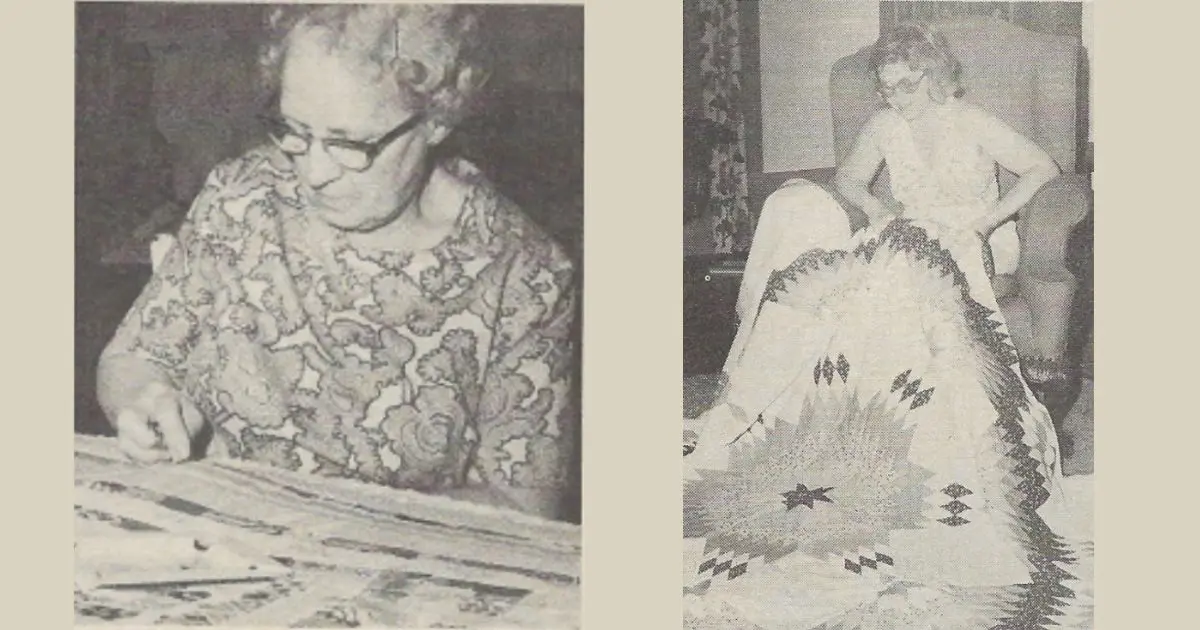
When Goldie Holmes made her first quilt some fifty years ago, she was a young bride living in a drafty farmhouse ill-designed for the Canadian winter. The quilt itself was a strictly utilitarian patchwork and there was no art in her sewing then. As she plainly puts it today, “It was cold and nobody could afford blankets.”
Goldie Holmes is still making quilts today, a practicioner of one of the few purely North American folk arts, a link with the homestead women of 200 years ago. Quilting is evolving at the hands of a new generation of patchworkers becoming at times very bold and graphic but it is still an art that makes something out of nothing. It has a rhythm all its own the up-and-down, in-and-out, the needle pushing down through the patchwork and up and out again in a seemingly ceaseless pattern of simple stiches.
It is a craft that speaks not only of beauty and warmth but of soul-satisfying economy and enterprise. A measure of the state of revival of quilting is pointed out by Kim Oondaatje, director of the film Patchwork Quilts, and the moving force behind a just completed two-year national show of specimen quality quilts.
“Recently, a friend in New York City sent me a notice from a Lexington Avenue quilt shop. The lowest priced quilt was $85 and most were priced between $100 and $200, with a few going up to $600.” That was in 1974, and this year’s Mennonite Relief Sale, Canada’s most famous annual auction, saw hundreds of thousands of people gather at New Hamburg, Ontario. Quilt sales reached a new pinnacle there with the auction of a single quilt for $1,000.
It all began when the first settler women from Europe reached this continent, bring ing with them the quilted coverlet, a form which had been invented in the 14th century when the climate took a sudden turn for the worse and temperatures dropped dramatically.
“Even politics got into bed in the form of such traditional quilt patterns as Whig Rose and Lincoln’s Platform”
Filled with feathers, moss and grass, two blankets were stitched together to keep the stuffing in place. As time passed, the pattern of the stitching became decorative and eventually embroidery was added. These coverlets came to North America with the British and European homesteaders, and as the material became worn, the precious heirlooms were patched -at first in random pieces, and later in appliqued designs. Thus the proud North American art of patchwork was born.
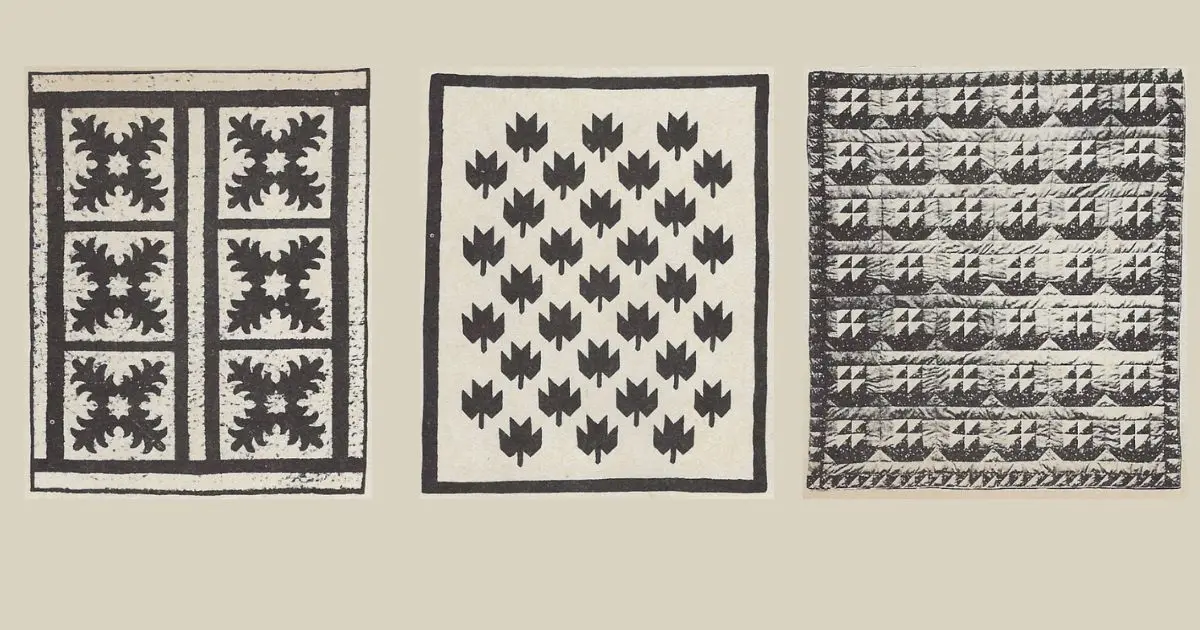
The piecing of quilt tops (the decorative upper portion) started out simply enough -bits of old clothes were sewn together. Later they were sewn into patterns, which in time were recorded and exchanged like bubblegum cards. The classic and often-repeated patterns ranged in name from the mundane, Corn and Beans to the sublime Bird of Paradise, each title reflecting its creators and her lifestyles.
Log Cabin, a pattern of rectangular shapes (see illustration), began, always, with a square red centre representing the hearth that was the heart of the home. Anvil, Churn Dash and Circular Saw all sprang from tools of the time. Melon Patch, Hen and Chickens and Goose Tracks spoke of the rural life of the quilters. Joseph’s Coat and Jacob’s Ladder developed with religious themes and even politics got into bed in the form of such traditional patterns as Whig Rose and Lincoln’s Platform.
The names were almost history lessons in themselves. The widely-known Lemon Star design is a bastardization of leMoyne, the name of the man who founded New Orleans and brother of another leMoyne who travelled down river from French possessions in Canada to settle Louisiana in the name of Louis XIV.
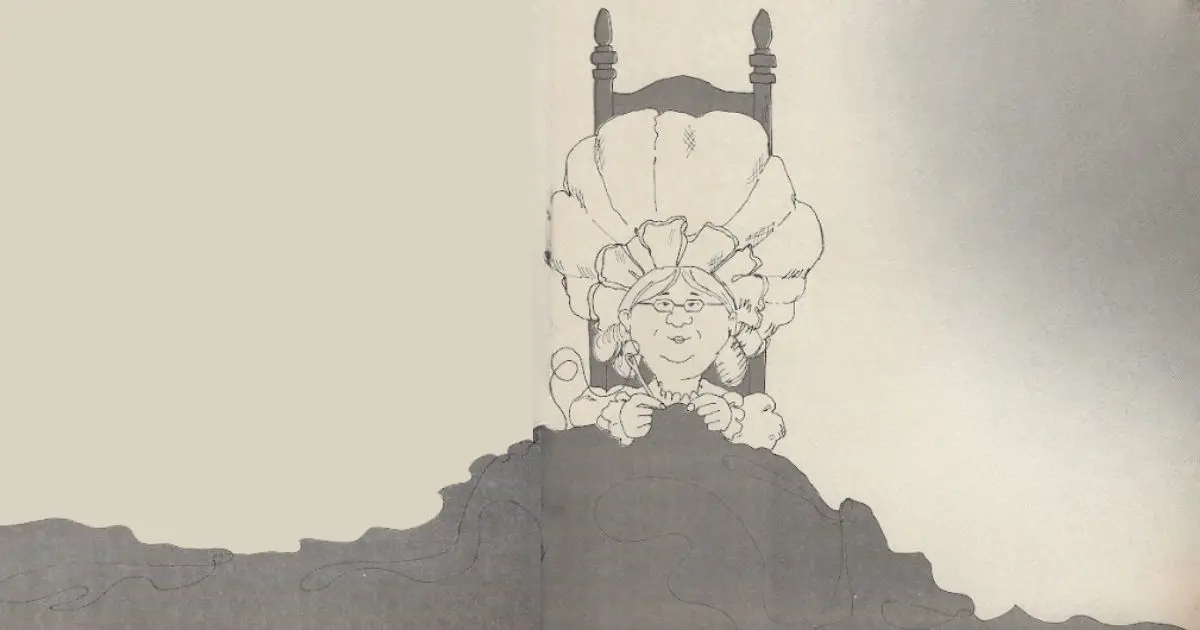
This link with history explains why many young women have taken up the piecing and quilting of coverlets. Susan Beevor, of Carrying Place, Ontario, became interested in quilts as a natural extension of her love of history and antiques. In a 200-year old home near the site of the landing of King George’s faithful Tories who were fleeing the American revolution, Susan turns out quilts to complement her early Canadian pine furnishings. For months at a time, Susan admits, the sitting room of her rambling home boasts a borrowed quilting frame where she sits and stitches the tops she has pieced.
“When you start quilting,” she says, “you forget everything else.”
Even the most experienced quilter can spend many months quilting a single coverlet. At the ideal “nine to the inch”, one coverlet probably contains a minimum of 25,000 stitches. It was this monumental task that gave birth to another North American Tradition: the quilting bee.
While they’re not often called that any longer, bees still exist, giving women the opportunity to get together for a time-honored reason, a little conversation and a good cause. Many senior citizens’ homes, church basements and drop-in centers boast quilting circles that meet weekly or even daily to make quilts for fund-raising auctions.
Whether it’s for the high-priced artisan quilts or the bargain-priced $25 most church groups charge to quilt a top for someone in the community, the real purpose of group quilting is the coming together just as it was 200 years ago. Then, a young woman began quilting and piecing at an early age, starting, perhaps, with the simple “nine-patch” pattern and quilting in the first and still most popular fashion, Echo which outlines the shape of the patched pieces. As her skill grew, the patterns became more complicated until she had completed a dozen quilts but no more.
The 13th quilt was a very special one, to be made only after she was bethrothed matter of luck. The quilt that was chosen was important, too, and no bride would ever choose Wandering Foot for her bride-groom lest sleeping under it give him wanderlust. Depending on location, a Rose of Sharon quilt, named for the sensuous Song of Solomon of the Bible, was popular as was the Bridal Wreath or Wedding Ring. In some areas, particularly the southern United States, the quilting party where the 13th quilt was always made together with the announcement of the forthcoming marriage often produced an Album quilt, with each quilter bringing her favorite block, embroidered with her own name.
Then as now, the women sat around the quilt, which was suspended on four notched or nailed beams sitting on the backs of four chairs. (In some homes where much quilting was done, the quilting frame was suspended from the ceiling by ropes and pulleys to be lowered for quilting and raised during the day when other work was going on.)
Each using a favourite needle, which had taken on a characteristic curve after many hours of quilting, the women sat around the frame chatting as they sewed, each taking pride in the small perfect stitches they were sewing. Quilts in pioneer times were, of course, made with scraps of old clothing.
The modern patchwork quilter, however, often chooses to buy new materials since an investment of that much time, many feel, deserves strong, colour-coordinated fabrics. To estimate the yardage required, being cautious means making a sample block, if only from paper, to determine the number of square inches of each type of fabric you will need.
Multiply that by the number of blocks most quilt blocks are 8 to 18 inches square and allow for seam allowances, borders and mistakes. When you buy fabric, be sure all of it is of the same weight so that in washing it won’t shrink at different rates. Pre-wash everything and discard material that bleeds colour.
When you decide on a pattern, cut out the various pattern pieces from fine sandpaper, which allows non-slip positioning when placed on the cloth. (Don’t use your good scissors for this job.) Next, lay out your fabric, single thickness, and draw around the sandpaper shape (grit side down), allowing an extra ¼ inch for seams. Lay the long side of the shape, incidentally, lengthwise on the fabric. Continue drawing until you have all you need. Each one must be drawn and cut individually to assure perfect patchwork.
To piece your quilt, you’ll need a thimble and a short No.10 needle along with new thread, either polyester or cotton. Thread your needle with about 20 inches of this and sew the pieces together with 4 inch seams, using a running stitch gauged at about nine per inch.
Backstitch at each end.
Piecing should begin with the centre of each unit. Press the seams to one side, not open. The pieced blocks should be joined into rows and the rows then joined together. Piecing can be done by machine, if you use 20 stitches to the inch. Curves, however, are extremely difficult.
The back of the quilt is most often muslin, solid cotton fabric or sheets made of cotton or flannelette. Make a seam in the middle if necessary. The back of the quilt should be four inches larger on all sides than the top.
While some people quilt their coverlet in their lap or with a small lap frame, the traditional method involves a frame. You can make a frame easily by connecting two lengths of 1 x 2 lumber to two shorter pieces with C-clamps, with the long sides crossing over the short sides. The long sides and the short sides should be 12 inches longer than the quilt’s length and width. Wrap the wood with doubled strips of muslin or scrap cloth which should be stapled or tacked in place.
Baste the quilt back, wrong side up, to the frame firmly. First baste the long sides, loosening the clamps and retightening to pull the back taut. Once the quilt is on the frame, it cannot be removed until it is finished since the same tension will never be achieved again.
Polyester batts are most often used today since they are easy to work with and inexpensive. Spread the batt, unrolling it
gently over the bottom.
Lay the pieced top over the batt, carefully centering it. Baste all three layers together on a diagonal, beginning in the center and working to the corners.
The actual quilting begins now and most modern quilters simply “echo” quilt, outlining the patterns by stitching along the seams of each block. If you’re using a pattern, draw it on the quilt with a hard lead pencil or purchase a perforated commercial pattern which comes with powder to be applied through the perforations.
When the piece is quilted, the backing edge is brought around and over the top, folded and blind-stitched into place.
Properly made quilts can both be washed and dry-cleaned. After every cleaning, inspect for broken threads and repair.
Sources
By the very nature of this craft, you don’t need anything you don’t already have to begin a patchwork quilt. Any household can produce the needle, thread, scissors and cardboard needed to begin. A couple of old blouses, shirts and rummage will probably be the fabric of your first patchwork blocks.
Sometime between that beginning and the time your top is pieced together, you can wander into any fabric store and buy a polyester quilt batt for about $5. Alternately, you can fill your quilt with an old blanket or two. The backing of your quilt can be seamed from two worn sheets. A 50 cent box of dye will make it the right color. And you can do the actual quilting in your lap if necessary.
FRAMES, HOOPS, HOOPLA
However, if the proper quilting thread strong waxed cotton appeals to you or you’d like a commercial quilting frame, they are available. Eaton’s and Simpson-Sears generally carry frames at about $20. Quilting thread, at about $1 a spool, is also available from these two department stores, as are patterns and quilt batts. You can even buy cotton patches by the pound, although these are somewhat pricey.
Patterns for the actual quilting are available from Dominion Wadding, 120 Vinet Street, Montreal, Quebec. Small newspapers almost always carry daily patterns from a feature syndicate, some of which are for quilting.
In the United States, a large quilting hoop – about 23 inches in diameter is available from the Merribee Needlecraft Company, 2904 West Lancaster, Box 9680, Fort Worth, Texas, 76107. This firm also sells a floor frame and extender on which you can make quilts up to 111 inches. Other quilting supplies. are available from this company which publishes a catalogue. Canadians should keep in mind that when you’re buying quilting supplies from the United States you’ll pay extra shipping and handling charges.
PUBLICATIONS
Canada Quilts, a quarterly publication for quilters, is available from Conroyal Publications, 360 Stewart Drive, Sudbury, Ontario, P3E 2R8. Another publication, this one U.S. based, is Quilters’ Newsletter, from Quilts and Other Comforts, Box 394, Wheatridge, Colorado, 80033. (Six months $3.) These people also sell patterns, plastic stencils, quilt kits and the like through a mail order catalogue.
To obtain quilt patterns, you can easily trace the shapes from a favorite quilt or draw them from a photograph in a book. However, there are a number of inexpensive books available which include cut-out cardboard patterns. Dozens of books on the subject of quilting can be found in any good library. Excellent choices are Quilting Manual, by Dolores A. Hinson, Hearthside Press, New York; Traditional Patchwork Patterns by Carol Grafton, Dover Publications, New York; Once Upon a Quilt, by Celine Mahler, Van Nostrand Reinhold Company, Toronto: One Hundred and One Patchwork Patterns, by Ruby McKim, Dover Publications, New York.
Originally written and published 50 years ago in 1976. Some information including sources may no longer be relevant or accurate.