
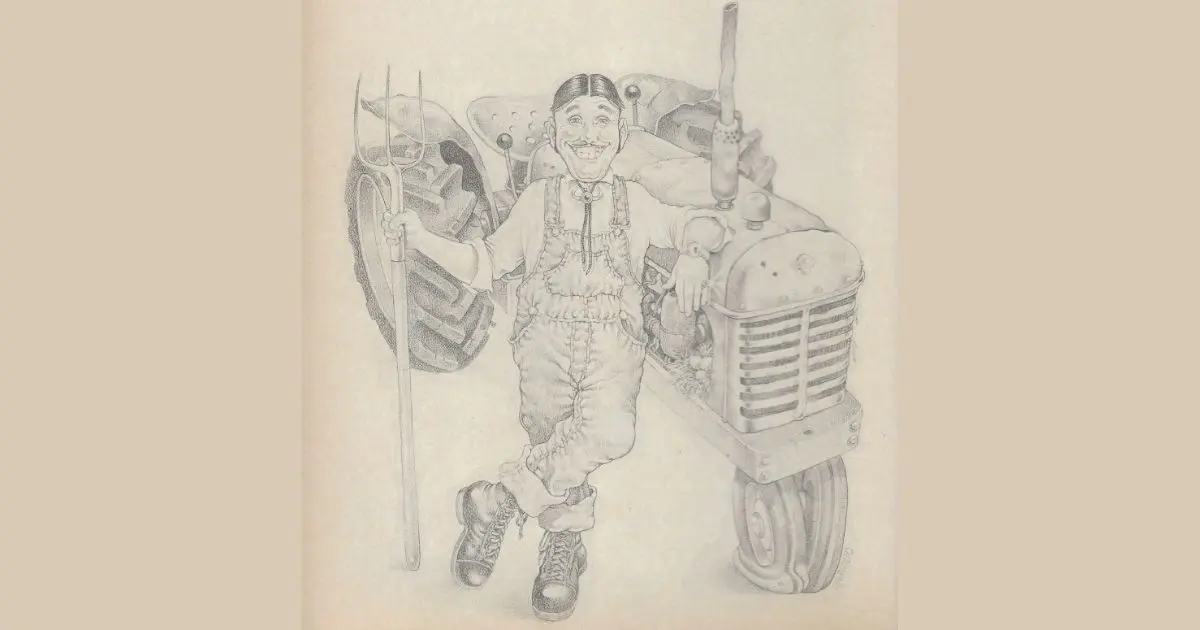
There were those who flatly predicted that a mechanical contraption would never replace the ever-faithful draft horse as North America’s primary source of agricultural power.
Although the clanking and sputtering machines rather quickly proved them wrong and drove the Percherons, Clydesdales and Belgian into near oblivion, we have no evidence that the horse trader allowed himself to be dragged into osbolsecence behind his merchandise.
Known for their resourcefulness, among other things, it is quite possible that many dealers in horse flesh saw what the future held, hung up their crops and currycombs and took a seat behind the desk of a farm implement dealer.
“Not that all tractor dealers are bad,” a neighbouring farmer explained recently when I approached him on the subject of buying a tractor. “Matter-of-fact, 90 per cent may be perfectly honest… but, well, they’re only in business for one reason. Something about the way he was eyeing me as I stood there in his barnyard in still-stiff boots and unfaded jeans suggested that someone like myself would prove a frightful temptation for even the most honest person trying to sell a used tractor.
Nevertheless, there comes a time when many new residents of the countryside find themselves ready to venture into tractor ownership. Assuming that a brand new machine is out of your price range, buying a used one takes just a bit of cautiousness to come through with your eyeteeth and reputation as a grass-roots businessman intact.
Many are the “hobby farmers” who have been taken in by a tractor with a fresh coat of paint and a dealer’s spiel that “these things never die.” The truth is that tractors built up to the end of the 1950’s were basic, simple machines without unnecessary frills. Unlike many mechanical devices, tractors then were made to last, and with a little care even the greenest newcomer to the land should be able to secure one of these low-priced dependable machines.
Before heading off to a farm auction or even leaning over the fence to ask a neighbour about that old Ford sitting unused behind the barn, sit down and seriously assess your needs. What jobs will you be doing regularly? Once-in-a-lifetime work, such as excavating or clearing land, can be done by custom operators, who can be found in all agricultural areas. Too, farm equipment can be rented for special jobs.
If plowing, tilling and snow removal are your major needs, think twice before investing in a tractor. A good rototiller and snowblower or two-wheeled plow might be cheaper and easier to maintain in the long run.
On the other hand, small riding garden tractors are not really practical for anyone whose agricultural ambitions are grander than tending a well-groomed lawn and postage stamp sized garden. These machines are designed to do a limited job well, but even their dealers will tell you that pushing them beyond a narrow limit will result in excessive wear and eventually in breakdowns. Furthermore, at $3,000 for a large garden tractor with a few accessories, they are by no means inexpensive.
“Up until the late 1950’s they were all made with heavy cast iron and straight steel, but then everyone started cutting corners, making lighter machines.”
If you feel your operation is not large enough to justify the expense of a tractor which will pass most of its days gathering dust in the barn, but still find the need for a tractor arising periodically, do not overlook co-operative buying.
There is a good possibility that you have a neighbour in a similar position, and your combined needs might justify buying a tractor. By all means know this neighbour as a true friend, and take peak periods of use into account. Many friendships have been destroyed as one partner in a joint equipment ownership stood by watching his neighbour plant that crop that he himself would never get in, due to the lateness of the season.
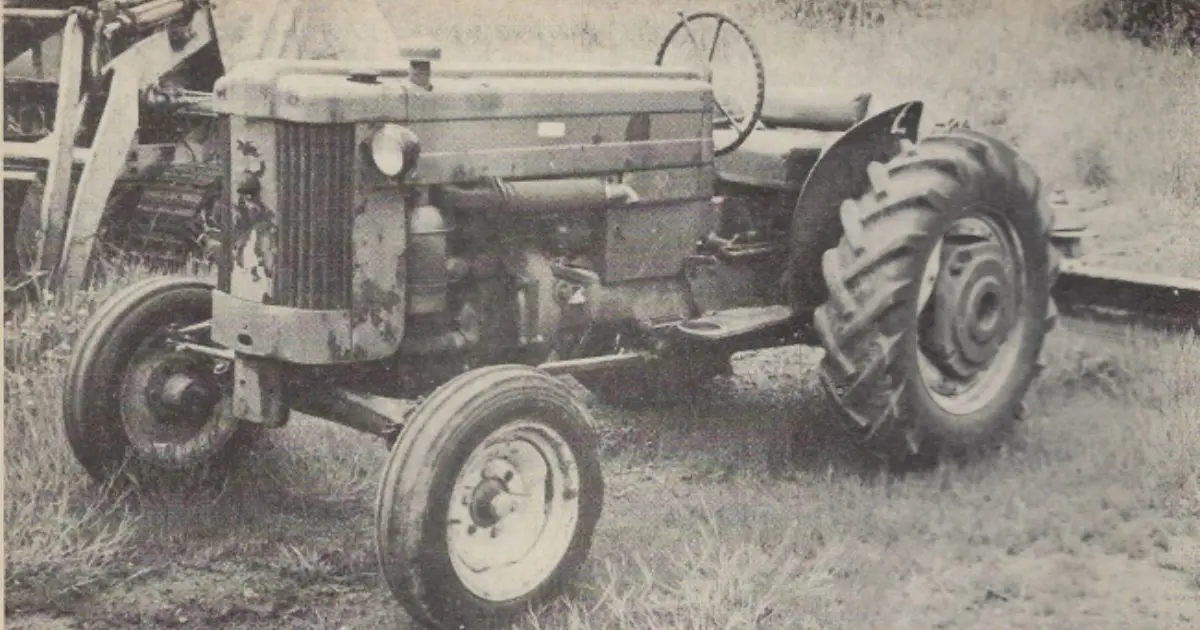
Knowledgeable sources agree that the best type of tractor for the back-to-the-lander is a small (20-30 horsepower), pre-1960
model.
“I would never buy one of these new tractors,” says Andrew Ptak, a former repairman for a Case dealership in Ontario. “Up until the late ’50s they were all made with heavy cast iron and straight steel, but then everyone started cutting corners and making lighter machines with alloys.
The newer tractors, ranging in price from $5,000 to $8,000 for the more modest sizes, also achieve their horsepower rating by higher engine speeds (RPMs). “The older tractors turned over much more slowly and therefore would last much longer. A slow engine with a heavy flywheel can develop the same power as a light engine at high RPMs, and last longer,” says Ptak.
Among the various manufacturers, none seems to have produced a notorious “lemon” between World War II and the late 1950s. Any of the Fords (the 8N, Jubilee and Major are all popular with small-scale farmers), Cockshutt, Allis-Chalmers, Case, David Brown, Oliver and John Deere are all wel respected for the quality and durability of their machines. “The Massey-Harris was also a good tractor,” says Ptak, “until the Ferguson interests came onto the scene and began producing cheaper, lightweight machines.”
Popular names like Ford, Ferguson, John Deere, and International usually have an available supply of parts, but by all means check first, for local tractor availability, or your tractor might well serve out its days as a rather bizarre piece of sculpture nestled among the weeds beside the barn, long immobilized because you can’t obtain that very small part which just happens to be crucial to operation.
To determine if the tractor is mechanically sound ask someone who knows the machine (and has no personal interest) about its condition. Try to do a compression test on the motor and have the hydraulic pressure checked. Check the plugs for excessive carbon deposits and also the oil for blackness and metal fragments. Play in the front wheels signifies faulty bearings, and dirty air filters or worn fan belts point to a lack of care on the part of the former owner. If there are still doubts, take the machine to a mechanic and have him go over it.
Buying a tractor at a farm sale can have some definite advantages. Often the tractor was really used by a real farmer until the day he died or quit, so it probably is in decent condition (then again, he may have quit partly out of frustration with the tractor).
You will have plenty of time to look the tractor over, while the rest of the farm is sold (the tractors are always sold last). If you feel nervous about it, this is the time to bring along a friend or pay a mechanic to examine the tractor for you. Listen to the old timers, for they may know about the tractor. Take the local gospel on tractors with a healthy measure of skepticism in this area a Cockshutt, for example, is usually talked down by the old-timers. It is, however, a fine, heavy tractor that can be bought
cheaply simply because it is regionally unpopular.
One important thing to take into account is the condition of the rear tires. If they are worn to the point of needing replacing, count on spending upwards of $150 apiece, a price which could gobble up a few year’s profits on garden produce without difficulty. Don’t automatically reject a tractor with poor tires, however. If the price is low enough, it may be very well worth your while to replace them to get a good tractor. (Cracking, excessive or irregular wear and gouges all spell tire trouble.)
One important choice you will face is whether or not to buy a tractor with a three-point hitch. This feature, a major advance in
tractor design in the 1940s, allows equipment (such as a mower) mounted on the rear of the tractor to be raised and lowered by hydraulic power. It is recognized by two arms that can be raised and lowered, with a third upper point of attachment.
The advantages of 3-point hitches are that they will take a very wide array of accessories, which are now standardized to fit all three-point hitches. Using the hydraulics, it is much easier to mount and remove equipment and it is also possible to raise equipment (such as a mower blade) to avoid hitting rocks while in motion.
Straightforward tow-type tractors are, however, much less expensive and may suit your needs perfectly. Furthermore, accessories for these older models can be picked up very cheaply at auctions everywhere. With this type of hitch, the implement is simply attached to the tractor’s drawbar.
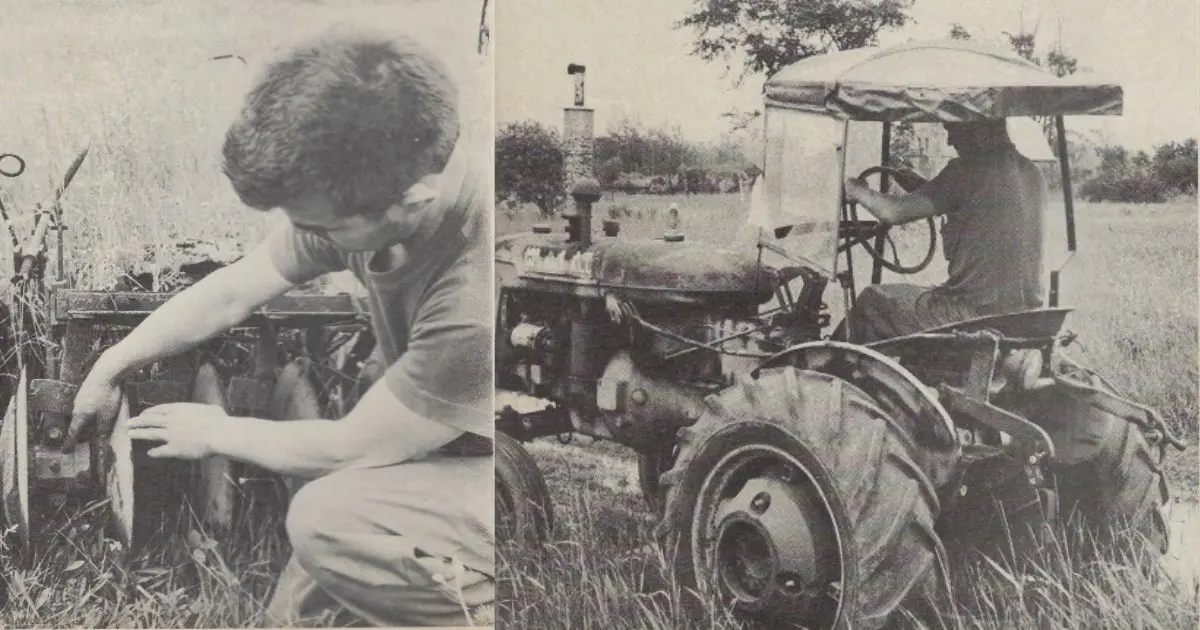
While all three-point hitch tractors have hydraulic systems, there also exist several older tractors that have hydraulics without the three-point hitch. Check where the hydraulics are located. Some are tucked well under the machine and extremely unhandy to reach (the hydraulic system can be used for a front-end loader or to lift tow=type equipment with a remote cylinder).
Country garages and local farmers can provide a wealth of information.
Decent plows, disk harrows and drag harrows are three basic pieces of equipment for ground preparation, and all can usually be had at auctions for less than $50. These older, modest pieces of equipment will serve the small farmer adequately, and full-time farmers are interested only in larger, more modern implements. For small acreages, a two bottom plow is about right.
Check plow points and bolts for looseness or breakage. The coulter, a metal disc which cuts the edge of the furrow wall, should not be chipped or badly dented and should fit snugly in its bearing. Disks on a disk harrow must be concave, and should be of uniform diameter. Remember that a disk harrow is made to turn the soil, not merely slice it, and if disks are not properly concave, they will do an inefficient job. Also check the boxings on the axle; there should be very little play between the axle and the boxing.
Although most farmers have given up on the old diamond peg harrow, in favour of chain drags, these older harrows are still useful tools and the lack of demand today makes them reasonably priced.
If you are looking at a peg harrow, check each peg to assure that it protrudes on the top side of the harrow. This protrusion means the peg can still be tightened with a hammer if it loosens. If the top of the peg is flush with the top of the harrow, it can no longer be tightened and will eventually fall out, resulting in the perfect spike to puncture a tractor tire on a later pass over that field.
The whole process of buying, fixing and maintaining a tractor is immensely more pleasureable if you know a good mechanic close-by. Tractor mechanics seem to have followed the lead of their cousins in the auto repair business. Many know nothing about the older tractors – indeed, many large new tractor dealerships don’t want anything to do with a tractor more than 10 years old. If you are not especially mechanical yourself, check with the small country garages in your area-some have people who grew up with the same tractor you are buying and will provide a wealth of knowledge and help. (Asking around might also turn up a farmer who repairs tractors as a sideline).
More and more boards of education and community colleges are offering basic courses in mechanics, and you might wish to enroll in one of these. A few basic tools should be obtained and kept around the workshop, along with a supply of parts which are likely to break, fall out or otherwise malfunction.
For the rest, don your filthiest pair of rubber boots, shove a wad of tobacco under your lip, and get out and start looking for that machine.
Originally written by Barry Estabrook and published 50 years ago in 1976. Some information me be out-of-date or irrelevant.
Buyer’s Checklist
The tractor can be the heart of a homestead’s power needs. The right machine can ease your workload, enable you to alter the face of your land for the better, give you spare time for family and friends and generally be a positive force in your home. The right tractor will do much more than field work – it is also a tool for land clearing, excavating, road building, snow plowing, pond building. It can be a portable power source for a compressor, generator and cord wood saw.
If your income is limited, remember that you will be buying and maintaining a machine that is usually operated by people who because of their income, can justify the cost. The wrong machine can eat dollars and time, both of which should be spent more wisely.
Can you afford to replace a $40 starter one day and be faced with another expense the following day? Even with the best machine it can happen. On the other hand, you may have to spend little on a tractor that gives many hours of trouble-free
service.
CHECKLIST
- Oil Pressure.
- Compression.
- Check oil in the sunlight for presence of filings, dirt, blackness.
- Ease of starting.
- Ease of shifting.
- Listen to idle is it smooth? Remember the 2 and 3 cylinder tractors sound very rough that’s their nature.
- Check tires, there should be no cord showing or replacement will be necessary. Odd sizes on the rear will blow the tractor’s differential.
- Check play in wheel to the king pins. There will be some in an old machines, decide what you can live with.
- Work the machine before you buy it. See how it feels under load-does it handle the work, or does it shudder and moan? Check that the governor cuts in when it hits load.
If You Buy From a Dealer
He is getting the top dollar for the tractor, and you can insist on more. Have a compression test and hydraulic pressure check done in your presence.
If You Buy At An Auction
Beware! There is very little that you can check.
If You Buy Privately
Take the tractor around the farm. Do some work with it. Above all, be sure there is a dealer handy who can get parts for that particular model and year tractor (be sure you can determine the model type and, preferably, the serial number-buying parts can be hell if you don’t know what you own). For example, in this area a Minneapolis-Moline would be a foolhardy purchase, because there are no dealers. Out west it could be a very good buy.
Finally, don’t buy a tractor just because it is a well-respected make or model-Ford makes a good tractor, but an abused Ford is useless, regardless of the manufacturer’s name.
Andrew Ptak, Centreville, Ontario
Originally published 50 years ago in 1976. Some information me be out-of-date or irrelevant.