
This article was written 50 years ago. Some info may be outdated Written by Frances Sheridan Goulard in 1976 – Issue #1
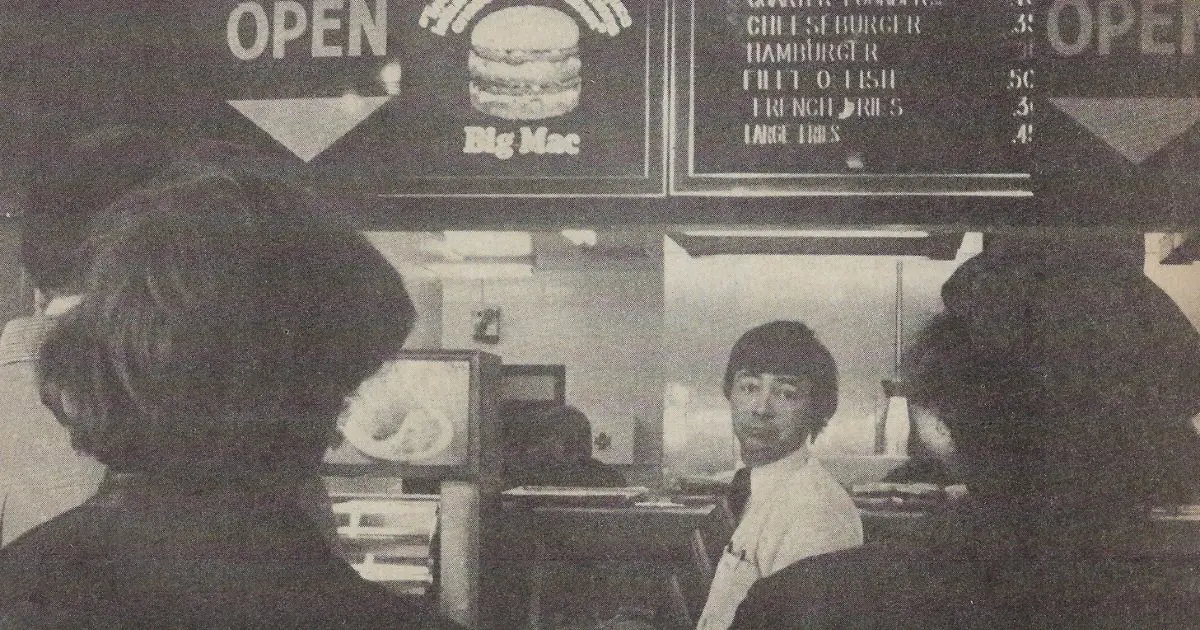
We have met the enemy, fellow travellers, and it’s a Greasy Spoon – a far cry from the humble Mom & Pop roadside stand that started it all in 1925.
Actually, it is so new and improved as to be greaseless and maybe even spoonless, too. “There is nothing at a McDonald’s,” says Harvard nutritionist Dr. Jean Mayer, “that makes it necessary to have teeth.”
Fast food outlets are now as omnipresent as the automobile itself, which in turn has evolved into what one observer called “an eating implement used to bring food to mouth.” And what sort of food has the new, improved Greasy Spoon brought to the mouths of motoring North Americans?
In the United States alone they account in large part for the 8 1/2 billion gallons of soft drinks, the 15 1/2 billion hotdogs, and the ten pounds of potato chips consumed per person last year. According to Statistics Canada’s latest figures, Canadians are close behind in their addiction to junk food, consuming an average of 17 gallons of pop and more than seven pounds of hot dogs per person in 1973.
More than ever before, Canadians and Americans are stepping up and eating out more than 50 per cent of the food we eat is now prepared outside the home. Almost one third of every dollar spent on food is spent on restaurant food, which “rarely contains the variety of vitamins and minerals needed for health,” according to George A. Briggs, nutritionist at the University of California.
Some restaurant foods are nutritional time bombs, high in what Dr. Mayer refers to as “the deadly trinity: cholesterol, sugar and sodium.” North Americans could cut almost 60 per cent of their cumulative medical bills if they practiced better nutrition, Briggs believes. Good eating habits could cut the incidence of heart and vascular disease alone by 25 per cent.
But while 85 per cent of the billions of dollars spent on vending machine food is devoted to items low in vitamins, minerals and protein (soda pop, coffee and candy bars), and while the profits of the McDonald’s chain have risen more than 365 per cent in the past three years, our consumption of fresh foods declines steadily.
We are eating 31 fewer pounds of fresh vegetables and 20 fewer pounds of fresh fruit per person than 20 years ago. (“A steady diet of McDonald’s fare is a sure road to scurvy, because it lacks suficient Vitamin C while providing large amounts of fats and calories with almost no roughage,” says nutritionist Mayer.)
Part of the reason may be that there is no one in the kitchen. Forty-four per cent of Canadian and American women now hold jobs giving them more time to spend in their cars, more money to spend on eating out and less time in the kitchen. The food you eat at a typical fast food Greasy Spoon may actually have travelled further than most travellers. McDonald’s French fries, for instance, are processed and frozen by the trillions at a central source in Idaho.
Kentucky Fried Chicken, whether eaten in Hackensack or Halifax, comes from distant central processing plants, in the Deep South of the U.S. or Southern Ontario in Canada. How old it is when you actually eat it is the Colonel’s well-kept secret, but it’s ready when you are because, as a clerk in one out-let confessed to a reporter, “People don’t want to wait five minutes.”
Satisfying highway hungers is very big business. Greasy spoon chains grossed eight billion dollars last year in the United States, with more than 40,000 drive-in chain restaurants. McDonald’s has surpassed the Army as the biggest dispenser of meals in the United States. There are well over 2,000 drive-in restaurants in Canada, grossing more than $200 million per year. Sales of potato chips and frills alone is another $200 million per year industry.
In addition to the expense (the days of Carroll’s 15¢ hamburgers are long past), eating out at the Greasy Plastic Spoons can be down-right depressing. With a minimum of forethought, however, you can avoid being at the mercy of the junk food outlets. Waging war with the monoliths is not easy, but the answer is a simple paper sack and a bit of ingenuity. Brown Bagging is more than it’s blown up to be, as those of us who’ve joined the bring-your-own rebellion have found.
Here are some up-and-at-em edibles you can buy (or grow) and which will see you happily past the Burger Kings, Harvey’s and Red Barns. The emphasis is on shunning the highly processed items and the estimated 80 per cent of today’s supermarket foods that are classified as “convenience foods.” Brown baggers need all the help they can get. Pulitzer Prizes are still being awarded for poetry. In a better world they would also be given for Best Brown Bag Lunches made without Miracle Spread, Wonder Bread or Skippy Peanut Butter
SUPER FOOD SURVIVAL KIT #1
Shirt Pocket Toast (Homemade Melba Toast): Put sliced whole-grain bread between squares of foil and press with steam iron until brown and skinny (tuck a few linen napkins underneath if you really want to save on energy).
Even tastier: ironing board toast made with cinnamon raisin bread.
Your Own Yogurteria: Take along your own hand-packed yogurt with all the trimmings (stick each extra in its own bag with a spoon or scoop) such as: Mocha-milk powder (combine carob powder with vanilla bean-scented milk powder or whey powder); nuts and seeds or granola; grated Swiss cheese or shredded radish and cucumber; finely scissored raw spinach with dried onion flakes; or crushed seaweed with sesame salt.
Vege-Toffee: Fill stalks of celery, fennel, rhubarb, scooped out spears of zucchini or yellow summer squash with bean pate or peanut butter, sprinkle with caraway or poppy seeds and wrap individually, twisting the ends of the wrapping to seal. Good dunked in mustard-flavoured yogurt.
Six-Pack of Mini-Juices (orange, apricot, grape): A laudable example of minimally processed supermarket food. Overpriced. but available without sugar and preservative-free (scrutinize the labels).
Dried Banana Sticks or Frozen Fresh Bananas: For the Candy Bar Break Substitute. Overripe bananas, which are nutritionally superior to firmer ones, can be frozen and packaged in foil. Skins will discolour, but inside will remain sweet and tasty, especially when only half-thawed.
SUPER FOOD SURVIVAL KIT #2
Mini-Can Sampler: Pack a basket with individual serving sized cans of tuna, shrimp, sardines. Expensive, but a low calorie, high protein alternative to junk food fare. Remember, a typical Greasy Spoon Hamburger delivers 557 calories, accompanied by another 500 calories and only 12 mg. of Vitamin C in an order of French fries, with no roughage at all.
Breadless Bread: Wholegrain waffles (try a mixture of millet, cornmeal, triticale and a cup of chopped bean sprouts). These are quicker to make than breads, don’t need to be sliced, and they freeze well, Pack them still frozen and they’ll be thawed by
lunch time.
Nest Eggs: Hard-boiled eggs packed in half an egg carton. If a hard-boiled egg is more seductive to your children when it’s painted the colour of cotton candy, why make them wait until Easter? Use beet juice for a natural dye.
Sprout Pouch: Keep some bean sprouts in the freezer (they store up to three months). Mix with fresh broccoli leaves and plain yogurt when they’ve thawed.
Cold Power Chunkies: Raw, enzyme rich natural energizers.
- 1/2 lb seedless unsulphured raisins
- 1/2 lb pitted dates
- 1/2 lb dried apricots
- 1/2 lb. dried apples
- 1/2 lb walnuts
- 1/2 lb almonds
- 1/3 cup orange juice
Put nuts and fruit through finest blade of food chopper. Blend in juice and press firmly into greased 8 by 4/2 inch loaf pan. Cover pan securely with foil and keep at room temperature for two to three days. Remove from pan and cut into cubes. Put away in little baggies for “energy crises” along the way.
Energy-Aide: Bring a thermos of hot milk to make fortified herb tea. Bring Slippery Elm Powder to make White Cocoa or Sassafras teabags for Hot Root Beer.
SHORT STOPS (Some semi-super foods to buy when you forgot to bring your own):
Nuts in the Shell: They’re probably gassed (so they’ll crack easier, processors tell us), but at least they’re raw, unsalted and sugar-free. And did you know that peanuts are the best protein buy in the market nowadays?
Eggs in the Shell: Most delicates-sens and most supermarkets with deli sections can sell you eggs, simply hard-boiled. And since they represent one of nature’s finest and most ignored foods (our consumption of eggs in this country has declined every year since 1944) they are a bargain at any price.
Some fertile eggs have been found to provide 600 per cent more Vitamin A than their supermarket counterparts, so should your short stop put you near a natural foods. store, drop in and enjoy some of the super food-in-the-shell.”
Fruit in the Skin: Besides apples, pears, tangerines, grapes, have your ever considered the luscious instantness of a ripe avocado which you can peel and eat out of hand? The avocado provides more energy pound for pound than almost any other food. It’s digestible as raw milk, contains high quality protein and Vitamins A, B, C, D, E, and K. If you’re near a farmers’ market or produce outlet, substitute a kiwi fruit or a fresh ripe persimmon for your fruit break. And since unsprayed produce is unlikely, tools like vegetable graters, and paring knifes are essentials.
Peas in the Shell: Come with their own biodegradable wrapping (take home and compost). Raw peas have 66 per cent more potassium and 1400 per cent less sodium than their canned counterparts.