
This article was written 50 years ago. Some info may be outdated Written by James M Lawrence 1976 – Issue #1
The most common advice from Harrowsmith staff members who can already by-pass the supermarket vegetable sections is to concentrate on several foolproof, highly productive crops. Save a row or two for your salsify, vegetable spaghetti or kohlrabi, but count on the following staples to fill the freezer:
- Snap Beans
- Potatoes
- Onions
- Tomatoes
- Corn
- Carrots
- Cucumbers
- Spinach
- Peas
- Squash
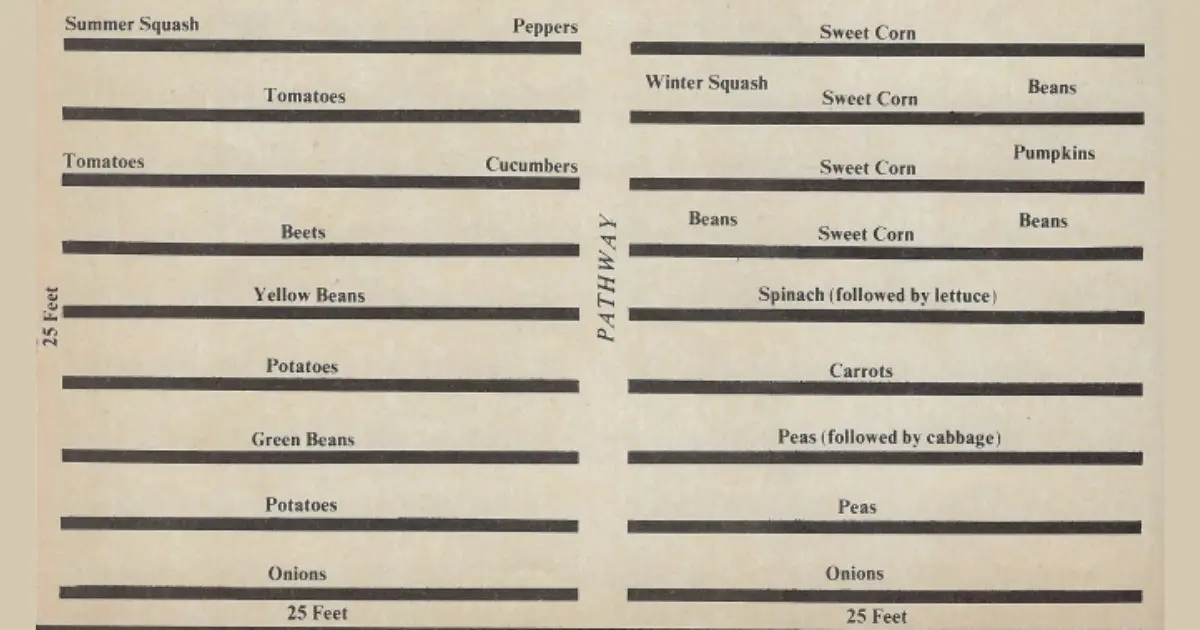
Although you will have to tailor your garden plans to the land available, experienced gardeners often end up after several years of trial and error with the bulk of their garden in short rows about 25 feet in length. One or two rows at this length will fill the average family’s needs for almost any vegetable, they point out.
Thus a very basic grid for two people could measure 25 feet by 50 feet, and fit nicely in many North American yards. Allowing a generous three feet between rows to give passage to a rototiller, there would be 16 rows 25 feet long in this garden.
If you’ve never had more than a 10 by 10 patch at a back doorstep but feel ready to get serious about gardening, try this plan. It can be tightened considerably if you are willing to control weeds by mulch and hoe rather than power tiller. Its production can easily be boosted by interplanting such vegetables as onions and lettuce throughout the garden wherever a bit of space appears.
Smart gardeners will also practice succession planting, quickly following a row of peas for example, by later plantings of beans, cucumbers or lettuce.
Hold The Zucchini
Too, the rows in this scheme can be doubled up. Planted six to eight inches apart, peas, beans, onions, beets and carrots will increase yields nearly twofold. (Gardeners with land to spare, however, often stay with single rows, to facilitate weed control. Double rows require a certain measure of extra hand work to clean in between where the tiller or cultivator won’t reach.)
In gardening on a large scale for the first time, there is a natural temptation to overplant some vegetables. Resist putting in a full row of zucchini. Even taking advantage of its easy freezing properties (slice and into the freezer), a 25-foot row of this prolific summer squash will leave fruits stacked like cordwood at the end of the season.
On the other hand, it is almost impossible to grow enough peas, which have a limiting factor in the time it takes to shell them. Growing a year’s worth of vegetables involves certain changes in your leisure time habits, most notably, at harvest times and right now when everything must be planned, planted and mulched in.
By staggering your plantings of peas and beans, however, you can spread the preserving time over a longer period of the summer. If freezer space is a problem. perhaps finding a second-hand re- frigerator is the solution.
Some people have found that, by removing the freezer compartment door and turning the thermostat setting to COLD, an old refrigerator is perfectly suited for storing frozen vegetables. Don’t over-tax it. Quick freeze them in another freezer or freezer compartment, and keep door openings and closings to a minimum.
Originally published 50 years ago. Some info may be out of date.