
For guidance on reading the tables for beginners – please go here
On the first of the month, the waxing Moon is in front of the Milky Way’s centre. So even from a dark site it will be difficult to see this mottled hazy band that crosses the summer sky.
Summer officially ends with the Autumnal Equinox at 14:19 on the 22nd, but the summer sky remains visible for another few months. And as the nights grow longer, we can enjoy the sky earlier in the evening.
The only planet in the evening sky that is bright enough to see from an urban area is Saturn in the SE. However, with a telescope you will also be able to see the much more distant Neptune 1.6° NE of Saturn. Saturn is 1.3 billion km away at magnitude 0.7, while Neptune is 4.3 billion km and 1/700th as bright (magnitude 7.8) – near the threshold for binoculars.
NOTABLE EVENTS
Sep 7 Full Moon
Sep 14 Last Quarter Moon
Sep 16 Sun enters Virgo
Sep 21 New Moon, Saturn at Opposition
Sep 29 1st quarter Moon, Saturn enters Aquarius
MONTHLY TABLE

Dates for the Phases of the Moon

Entries are in Eastern Time and only require time zone correction. Do not use the correction from the “Ottawa-Time” table. Saskatchewan and parts of BC and Ontario do not use daylight savings. In these regions, subtract 1-hour from these times from March 10 to November 3.
Planetary Configurations
When at Opposition, planets will appear on the opposite side of the sky from the Sun – very roughly on the meridian at midnight. Conjunctions are when the planet has the same “longitude” as the Sun. A Superior Conjunction is when the planet is on the other side of the Sun, and an Inferior Conjunction is when it is between the Earth and the Sun. Only Mercury and Venus can be at Inferior Conjunction. Maximum elongation is when Mercury and Venus appear farthest from the Sun in our sky. This occurs either in our morning eastern sky (mor.) or our western evening sky (eve.). Do not apply the Ottawa-correction times to the times in this table.

Prominent Constellations by Seasons

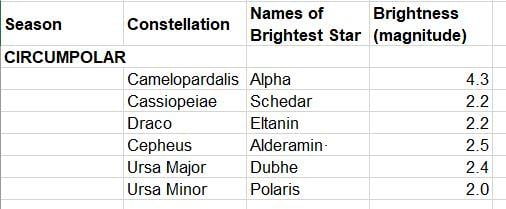
Brightest Stars