

For guidance on reading the tables for beginners – please go here
The month begins with the 1st quarter Moon in the SW and the centre of our Milky Way galaxy close to the horizon in the south. However the brightening Moon will overwhelm the faint light of the Milky Way.
The activity from the famous Perseid meteor shower will peak on August 12-13. Late evening meteor-observing will only be good until 22:00 when the Moon rises in the east. The Moon will be just past full so its light will overwhelm many of the fainter meteors for the rest of the night. If you are busy or it is cloudy on this night, try observing for a few nights before and after this date.
As the second week ends, we see Saturn just above the eastern horizon in the constellation Pisces. This will help to compensate us for the loss of Mars last month.
High overhead on the 15th the bright star Vega, the western-most star of the Summer Triangle crosses our meridian at 10pm, followed by Deneb, and the more southern Altair two hours later.
NOTABLE EVENTS
Aug 1 1st quarter Moon
Aug 9 Full Moon
Aug 10 Sun enters Leo
Aug 12 Perseid Meteor Shower
Aug 16 Last Quarter Moon
Aug 19 Mercury at greatest evening elongation
Aug 23 New Moon
Aug 31 1st quarter Moon
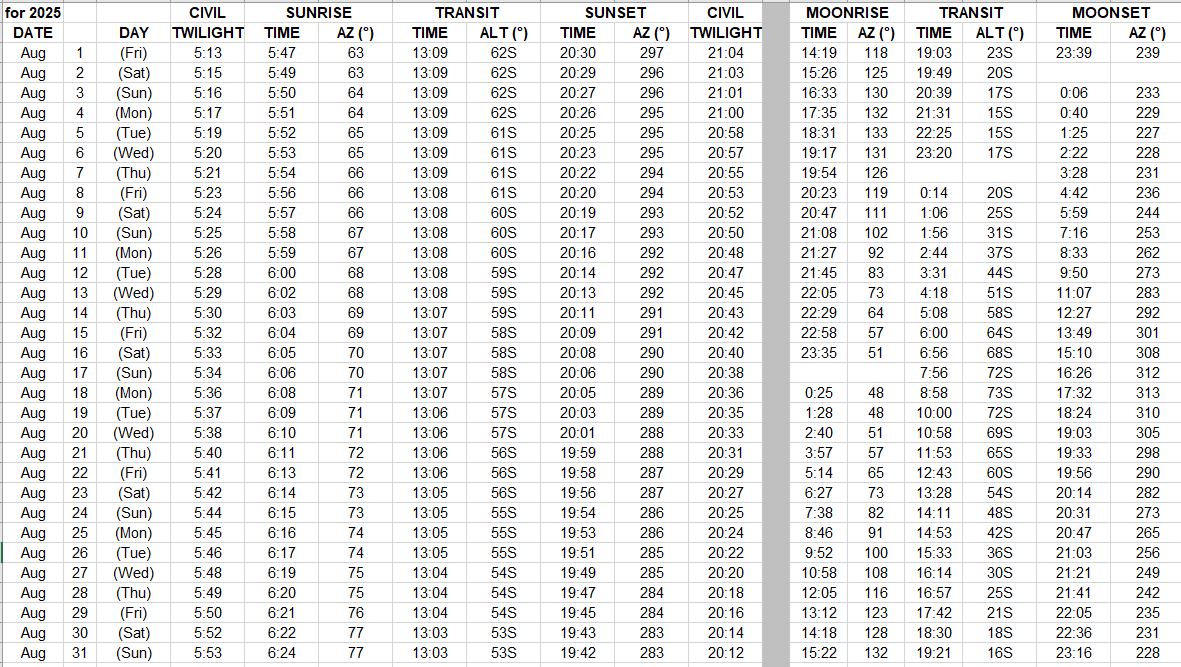
MONTHLY TABLE
Main Meteor Showers
Meteor showers are best observed after midnight when our hemisphere is ploughing into the meteor stream. Although the duration of the most active portion of the shower is short, some shower meteors can be seen many days on either side of maximum.
The activity from the famous Perseid meteor shower will peak on August 12-13. Late evening meteor-observing will only be good until 22:00 when the Moon rises in the east. The Moon will be just past full so its light will overwhelm many of the fainter meteors for the rest of the night. If you are busy or it is cloudy on this night, try observing for a few nights before and after this date.

Dates for the Phases of the Moon

Entries are in Eastern Time and only require time zone correction. Do not use the correction from the “Ottawa-Time” table. Saskatchewan and parts of BC and Ontario do not use daylight savings. In these regions, subtract 1-hour from these times from March 10 to November 3.
Planetary Configurations
When at Opposition, planets will appear on the opposite side of the sky from the Sun – very roughly on the meridian at midnight. Conjunctions are when the planet has the same “longitude” as the Sun. A Superior Conjunction is when the planet is on the other side of the Sun, and an Inferior Conjunction is when it is between the Earth and the Sun. Only Mercury and Venus can be at Inferior Conjunction. Maximum elongation is when Mercury and Venus appear farthest from the Sun in our sky. This occurs either in our morning eastern sky (mor.) or our western evening sky (eve.). Do not apply the Ottawa-correction times to the times in this table.

Prominent Constellations by Seasons

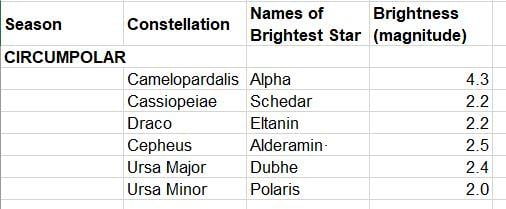
Brightest Stars