
A tractor is one of the most useful pieces of equipment for hands-on rural living, and choosing the right used model is key to getting full value for your money. As professional farmers get bigger, they need bigger equipment, and this means that good, used, smaller tractors become available at reasonable prices for owners of small properties. I bought my first tractor in 1986, another in 2015, and I’ve just bought a third used tractor this spring. I also do most of my own tractor repairs, so I’ve come to learn what it’s like to keep an “old iron” working on the land.
Two Kinds of Tractors
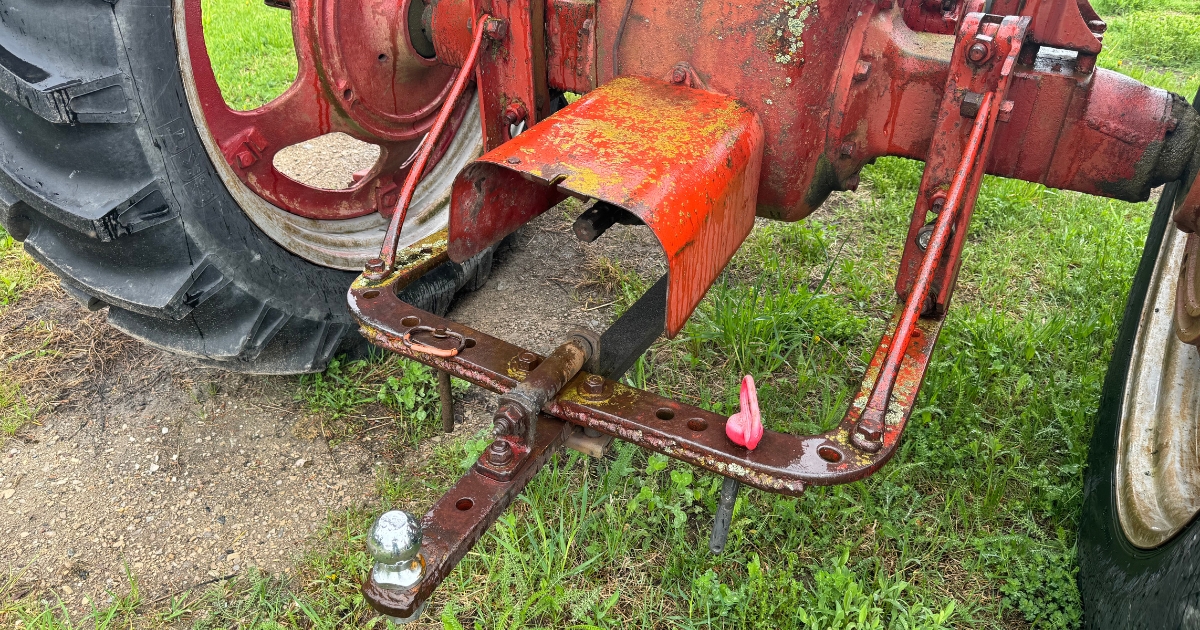
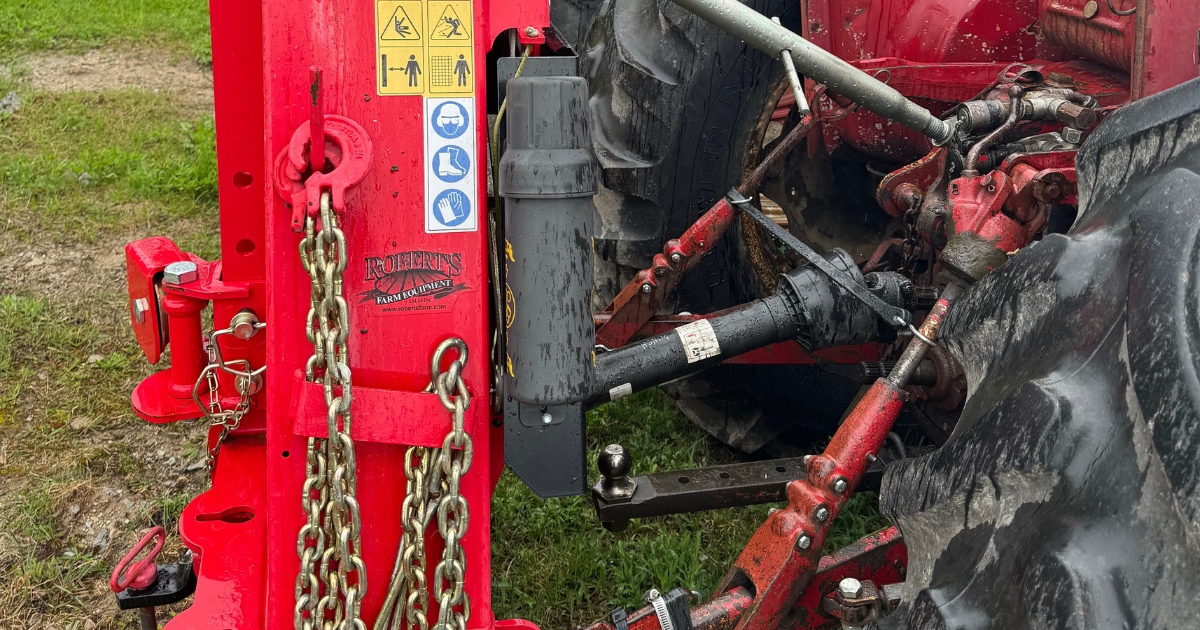
There’s a fundamental dividing line in tractor design that appeared in the late 1950s, and you need to understand this issue to make an informed purchase. The mid-to-late 1950s is when factory-installed three-point hitches and hydraulics began to appear. This is also the era when tractors began to use diesel engines in a big way, instead of the gasoline engines in tractors made before this time. A three-point hitch is a universal system that allows tractors to connect with all kinds of equipment from any manufacturer. Hydraulics allow special implements, loaders and buckets to be powered by tractors and this increases productivity.
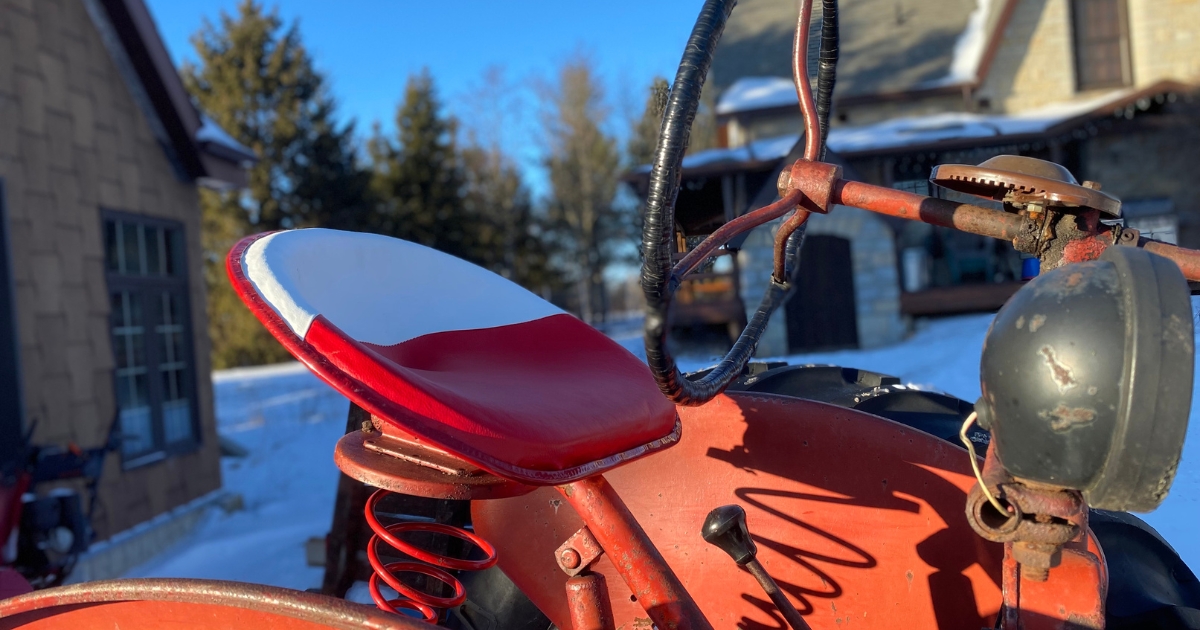
Earlier tractors, with neither a three-point hitch nor hydraulics, are only useful for pulling simple things like harrows, hay rakes and wagons, but this might be all you need. That first tractor of mine was a 1953 Farmall Super H that I bought for $1,000 in 1986 (it was all I could afford), and it’s worth $2,000 to $3,000 today. And though this simple, reliable machine is still working well for me 71 years after it rolled off the assembly line, the 1977 International H84 I bought in 2015 for $3,500 (with snow blower and brush hog mower) was great because it has a three-point hitch, loader and bucket. This is less than the price I paid for a new high-end lawn tractor, and the same as a walk-behind snow blower, so it’s a great value.
Steer clear of very old tractors without a three-point hitch and hydraulics unless you only need to pull things. My Super H is still quite useful as a secondary tractor and I use it for hauling wagons and harrowing my pasture, but a more modern tractor can do this, too, and much more.
There’s one other fundamental tractor design feature that’s exceptionally useful, and it’s why I just bought a John Deere 5500 made in the second half of the 1990s.
Two-Wheel or Four-Wheel Drive?
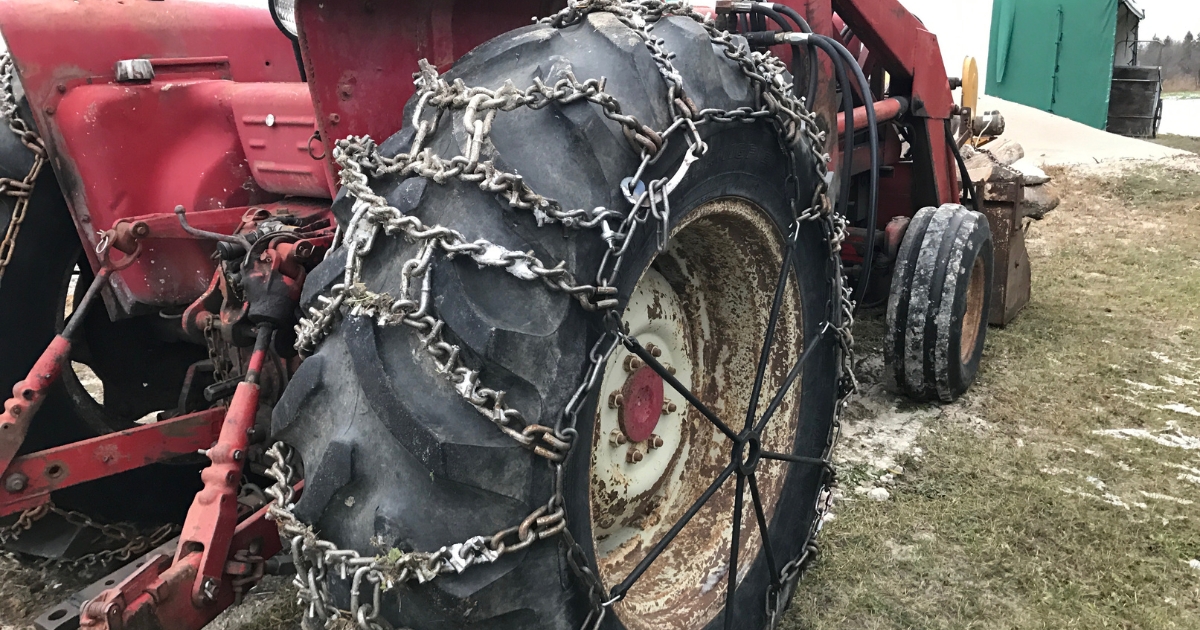
If you haven’t used a tractor much, you’d be surprised how much more traction a four-wheel drive has than two-wheel drive models. The difference is enormous. My two-wheel drive H84 is pretty much useless in the snow with bare tires, even though the tread still has a lot of wear left. That’s why I install chains on the rear wheels every fall in preparation for blowing and pushing snow. But even with tire chains (which are surprisingly expensive, heavy and a twice-yearly hassle to install and remove), my H84 isn’t very good at pushing snow. Tire chains also make for a rough ride when driving on pavement, and this is why they should come off in the spring.
My “new” 27-year-old John Deere has four-wheel drive, and though this feature adds considerable expense and mechanical
complexity to the tractor, it also greatly increases traction and usability. This is why four-wheel-drive tractors are so popular today.
If budget permits, you won’t regret buying a four-wheel-drive model. You can tell them from two-wheel drive at a glance because four-wheel-drive models have lugged tires for traction on the front end.
The Electronics Issue
As with road vehicles, farm tractor design underwent a major change as electronics began to control tractor systems and improve fuel efficiency. What’s not so obvious is how troublesome and unreliable electronics can sometimes be. I have a neighbour who paid more than $100,000 for a large, brand-new, name-brand tractor that proved so troublesome with repeatedly failing sensors and other electronic hassles right from the start, that he traded it in after months of runaround and headaches. Are all new tractors a pain in the butt electronically? No, but it happens often enough that you might consider avoiding new models for this reason. Electronics also make it much more difficult to do repairs yourself, and offer more things to go wrong.
It wasn’t until after the 1990s that electronic systems on new model tractors became widespread, so that’s another watershed evolution to consider. One reason I chose the John Deere 5500 was because it has only a small amount of electronics. Parts are also reasonably priced and widely available, which is not always the case with every brand.
Remarkably, parts are still widely and economically available online for my old 1953 Super H.
Transmission Options
There are a handful of different transmissions in tractors. My own preference is for a simple, fully mechanical clutch and gear transmission because it’s uncomplicated and reliable. Don’t worry if you haven’t developed the skill to drive a road vehicle with a manual transmission – driving a fully manual tractor is far easier. Other transmission types include:
- Power shift: Similar to simple mechanical transmissions, but with the ability to change gears without using the clutch. This makes for faster, smoother gear changes on the fly.
- Hydrostatic transmissions: These use hydraulic pumps and motors to drive the tractor, not a clutch and gears, offering infinitely variable speed control.
- Continuous Variable Transmission (CVT): This is as close as you’ll come to a tractor version of an automatic transmission. Gear ratios are automatically adjusted to travel speed and load.
- Power reverser transmissions: This allows faster and simpler gear changes from forward to reverse. This is most useful when cleaning out a barn regularly or engaging in other tasks that require frequent changes of direction.
- Power shuttle transmission: This allows switching into and out of gears quickly and without using the clutch.
How Much Horsepower?
That Farmall Super H I bought in the ’80s was leading-edge when it was built in Rock Island, Illinois, in 1953, and its 32-horsepower engine was considered substantial at the time. By comparison, today’s largest production tractors have 10 times this much power.
So how much horsepower does an active, small landowner need? That depends on the work you plan to do. Today’s new sub-compact and compact tractors provide 25 to 50 horsepower, but numbers like these are no substitute for experience. When I bought my H84 with 60 horsepower I thought it was way more than I’d ever need power-wise, but I was wrong. I regularly use all this power when blowing snow and lifting heavy things with the loader. In my experience, it makes sense to err on the side of choosing more power rather than less.
Many rural landowners who don’t farm full-time are happy with tractors in the 25- to 50-horsepower range, and this can do all the usual tractor tasks, though perhaps not as quickly as models with more power. My John Deere has 73 horsepower, which is probably more than I need, but we’ll see.
Buying Wisely
The single most useful source for choosing a used tractor is finding someone local who knows mechanics and tractors and can offer opinions. I’m lucky enough to have a friend who is both an experienced licensed heavy mechanic and a full-time farmer. His advice has been so valuable when dealing with repair issues and when choosing that used John Deere I just bought. Beyond advice and opinions, you should understand how usage is measured and recorded on tractors.
How Many Hours?
Road vehicles have odometers, and distance travelled since new is the way you tell how much use a car or pickup truck has endured. But with tractors, things are different. Their usage is measured in hours of run time on a dashboard read-out that advances whenever the engine is running. It doesn’t matter whether that tractor is travelling at 1 km/h or 60 km/h, the hour-meter still runs the same. So, what are high and low hour figures for tractors?
Top-quality brands should be able to operate for 8,000 to 10,000 hours before significant issues happen, and half this much time for lower-quality, lighter-built tractors. Some particularly durable tractors occasionally go for 30,000 hours of operation on the original engine and transmission. It all comes down to design and whether or not maintenance happens when it should, especially when it comes to engine and gear oils.
Rural Life Enhancement
Over time, you’ll find that a good tractor becomes a useful work partner and a powerful ally when it comes to many rural activities. It’ll help make all kinds of accomplishments on your property possible, and a used model will do it for a reasonable amount of money. This is why so many people feel a certain affection for their old tractors. Choose wisely and you’ll wonder how you ever got along without your four-wheel friend.
Simple Details to Look for Before Buying
How much tread is left on the tires? New tires for even a small tractor can easily cost $4,000 to $5,000, so the wear left on the tires of a used tractor really matters.
How tight are the loader pins? This is the pivot point on a loader so they can raise or lower a bucket, hay spears or pallet forks, and long use can make these pins sloppy in the hole they rotate in. The less slop there is in pivot pins, the better.
How well does the engine start? Most diesel engines require warming to start well in cold weather, but any good tractor
engine should start right up in warm weather, even after sitting for a while.
How well do the hydraulics work? Hydraulic operation of a loader or bucket should be instant and smooth, ideally with no sinking of the loader when it’s raised and the engine not running. Hydraulic pumps wear out, with some models offering easier replacement than others.
Advice for Buying New
If you’ve got the money and inclination to buy a new tractor, there are two things to keep in mind. Brand matters a lot, and popular names like John Deere, Kubota, New Holland and Case IH are all worth looking into. But just as important as brand is dealer support. When you buy a new tractor, you’re also buying the skill, diligence, warranty service and helpfulness of a dealer. There can be big differences from dealer to dealer, so ask friends and neighbours about their experiences before you buy.
A Few Tractor Tips
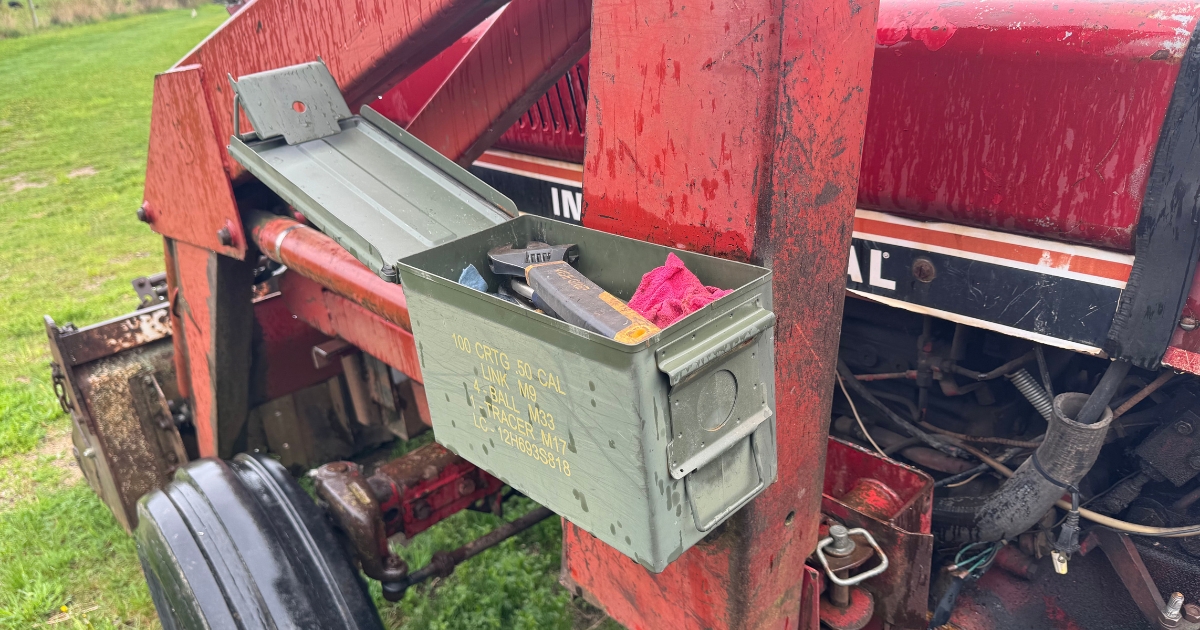
It’s not unusual to need tools when using a tractor and other equipment out in the forest or fields, and this is why I mounted weather-sealed steel surplus ammunition boxes to my tractors. They offer a place to store locking pins, pliers, wrenches, a hammer and other essentials in a place that stays reliably dry.
Another thing to keep in mind is the need to warm up tractor engines in cool or cold weather. This is mostly an issue with diesels, and it’s why I installed an electrical outlet to power a block heater in the spot where I store my tractor. My H84, for instance, won’t start without pre-heating when it’s any colder than 10oC. This is normal for this model. My Super H, being powered by gasoline, starts in any weather without preheating.
One of the hardest things on tractors is being outdoors all the time. Sunlight and moisture take their toll on paint, rubber, seats and plastic. Indoor storage is an important piece of TLC, if you have the option.