
This article was written 50 years ago. Some info may be outdated Written by James M Lawrence 1976 – Issue #1
As this excerpt from Rural Afairs: A Practical and Copiously Ilustrated Register of Rural Economy and Rural Taste shows, in 1865 there was but one way to garden without chemicals. Although the language is at times curiously archaic and some of the terms dated, modern gardeners may find these century-old horticultural tips applicable even today.
Kitchen Slops & Tomatoes
N.K. MERIAM, of Grafton Station, Mass., has adopted a simple and cheap expedient for growing early tomatoes and disposing of the slops from the kitchen at one operation.
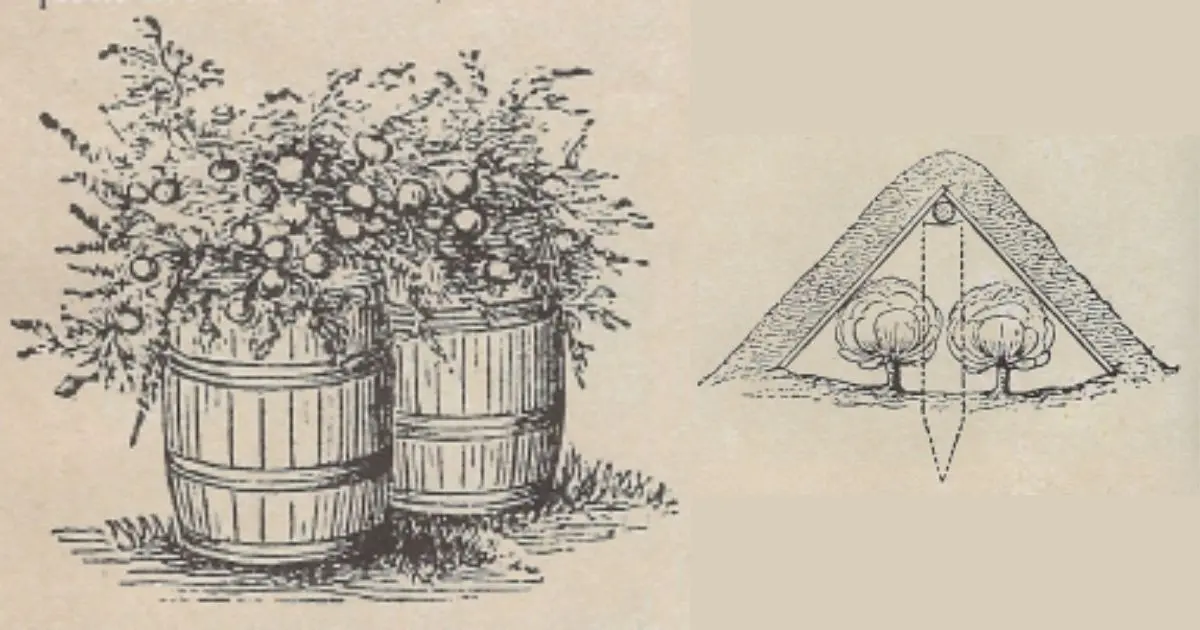
The kitchen yard is in a warm, sheltered place, with a Southern exposure. Barrels are placed near the wall, nearly filled with rich earth. In these, tomato plants. are placed early in the season, and may be easily covered up on cold nights. As the plants grow and increase in foliage, and thus throw off large quantities of moisture, the kitchen slops are poured into the barrels for watering the plants. The warmth, moisture, and elements of fertility thus supplied, produce an early growth; while the confinement of the roots in the barrel prevents too much running to stem at the expense of fruit.
The barrels should not be water-tight, but admit of drainage. Any number of barrels may be thus placed in a row, and be planted with cucumbers and other vegetables. If properly trained, they present a neat and ornamental appearance, and the barrels serve as reservoirs, to get rid of kitchen slops, so often a nuisance about kitchen doors.
To Keep Squash Bugs Off
Knock the bottoms out of cheese boxes, nail on screen cloth, and set them over the hills of squash. When not in use, pack them away, and one set will last a number of years.
Liquid Manure
This mode of applying manure has one great advantage over the common way of enriching land for gardens. It passes in among all the particles of the soil, and is thus more intimately diffused than any mixture of solid manure in lumps. On all vegetables that require strong fertility, its results are excellent such plants, for instance, as asparagus, rhubarb and celery.
A correspondent of the Country Gentleman says: “Those who would like to try this system in their garden should sink a hogshead into the earth in a convenient corner of the garden, and liquify guano, hen manure, cow dung, urine, &c., &c., with from six to ten or more times their bulk or weight of house slops, suds or soft water.
After thorough stirring to secure a solution of all the fertilizing elements, allowing the solid or sedimentary portion to fall to the bottom apply the liquid by a watering can, hydropult, or other apparatus, to the crops after or about sundown.”
Heading Cabbages For Winter
It often happens that many cabbages have not formed heads in autumn on the approach of winter, and these are usually rejected and thrown aside. The mode we have adapted to produce heads from these has long been known to some of our readers, but we discover it is rarely practiced.
A brief description may therefore be useful:
Take up all these plants and set them as closely as they will stand, in a double row, in their natural. position in a wide and shallow trench. Form an earth roof over them, in the following manner: Set in a piece of upright plank at each end to support the ridge pole. Place a rail or still pole on these for the ridge pole, and on this the ends of short pieces of boards to form a roof.
Cover these boards with about six inches of earth; or enough to keep the soil in which the cabbages stand from freezing. This is the whole operation. Nearly all will be handsomely headed by spring, and being entirely excluded from light, they will be more delicate both in appearance and flavor, than common cabbage heads. Two hours of labor last autumn gave us a fine supply of cabbages for a moderate family nearly through the spring.
Culture Of Asparagus
Our readers will doubtless remember that we have often urged as a very essential requisite, to give asparagus plants plenty of room this being more important than to make a very deep and rich artificial bed for them. Dr. KENNICOTT states, in a late Prairie Farmer, that he has a bed set out twenty-four years ago, in rows four feet apart, and cultivated like corn, by horse power.
All that it costs him to supply a table of twenty or more persons for two months, is less than the expense of a dozen messes of green peas. Any soil, he observes, fit for a premium crop of corn or potatoes, is fit for an asparagus bed, without any preparation. It is annually dressed with manure in autumn, plowed and forked under in spring.
Usefulness Of Toads In Gardens
At a recent meeting of the Brooklyn Horticultural Society, the subject of toads in gardens was under discussion, when Mr. BURGESS, an “old country gardener of long experience,” stated that “thirty years observation had convinced him that it was the snail and not the toad which devoured strawberries and their vines.”
Most people attributed the destruction to toads, but he was certain that they were harmless. In gardens he considered them of great use, and all gardeners should look upon them as friends. Mr. FULLER endorsed all that had been said upon the subject, and he was glad to hear it.
Gardens Late in Summer
Farmers who raise kitchen vegetables, and who do not keep a regular gardener, are apt to neglect their grounds towards the end of summer and early in autumn, and allow weeds to ripen their seeds. Nothing reduces the current expenses of a family, for the outlay, more than a good kitchen garden; but the complaint with many is the labor of keeping it clean the constant fight with weeds, weeds.
Some have adopted the opinion that a quarter-acre garden will grow more weeds than a ten acres of farm land, and there is ground for the belief, as some are managed. A few weeds, allowed to perfect seeds, will produce an abundant crop next year; and thus, year after year, the earth becomes filled with them, till the soil of a garden consists of three main ingredients, namely, a soil, naturally; a large amount of manure, artificially; and an immense supply of foul weeds, spontaneously.
It is not practicable to clear out entirely and totally, the last of the three? Are weeds a necessity? If a garden contains a hundred thousand of them, and ninety-nine thousand are killed by the hoe, why not the remaining thousand? If nine hundred and ninety of this thousand, why not the remaining ten?
THE SOIL OF A GARDEN MAY BE COMPLETELY PURIFIED OF WEEDS AND THEIR SEEDS, greatly reducing the labor of keeping it in order, and largely contributing to a fine growth of the crops. It is easier to keep a garden perfectly clean, than to be engaged in a constant warfare with the weeds.
Nearly all farmers are satisfied if a garden is NEARLY clean. This is the origin of the problem all the trouble namely, leaving a few weeds to seed the whole ground. The remedy is eradicate everything and then, in three days, go over again, and eradicate anything that may have shown its head, and so continue the examination every week, weeds or no weeds.
It is easier to spend a half hour in a morning once a week in this way, and have good crops, than to spend three days in each week fighting the intruders, and as a consequence, getting bad crops.
Originally published 50 years ago in 1976 in Harrowsmith’s 1st magazine from an excerpt from Rural Afairs: A Practical and Copiously Ilustrated Register of Rural Economy and Rural Taste shows, 1865.