
This article was written 50 years ago. Some info may be outdated Written by Ann Botterell in 1976 – Issue #1
When Ann Botterell drives down the highway in her Volkswagen Rabbit, she sometimes appears to be a two-headed driver. Passing motorists have been startled to see that the second head belongs to a large black ram, leaning forward from the back seat to rest his chin comfortably on the driver’s head.
The six-year-old Finnish Landrace ram is accorded the special treatment as the sire of Ann’s small flock of sheep and as a regular contributor of fine black fleeces for her spinning projects. Aside from the chauffering of sheep down the highway to the shearer, Ann treats her flock and their wool much as it was done hundreds of years ago: cleaning, carding, dyeing with natural colours, spinning and then weaving or knitting it herself.
Formerly residents of Montreal, Ann and her husband Edward moved back to the land eight years ago, by buying a 148-acre farm near Inverary, Ontario. Originally a weaver, Ann had learned to spin, and having land suddenly gave her the opportunity to raise her own flock of woolies.
Today, Ann is involved with a small group of fellow “spinsters” who meet once a fortnight for a day of uninterrupted work. They sponsor workshops, exchange information, and help others learn the art of spinning, which is not easily self-taught. The group rarely uses chemical dyes and quite often doesn’t even wash the wool they use.
Like many other weavers around the country, the individuals in this group swore they would never get into spinning but have been irresistibly drawn to the activity that naturally precedes their main love of weaving. They claim spinning to be a healthy change from the loom. It is very relaxing. You can be quite social while spinning, Ann says, and the wheel is much more portable than a loom. Doreen Jeffers, a member of the same spinning group, even takes her hand-spindle on camping trips.
For weavers, knitters and anyone else thinking about trying their hand at spinning, but who do not know much more about the process than that Sleeping Beauty somehow pricked her finger at a spinning wheel, the following is a compilation of tips and observations from Ann Botterell and Doreen Jefers, both regarded as qualified teachers of the spinning art.
Origin & Mechanics
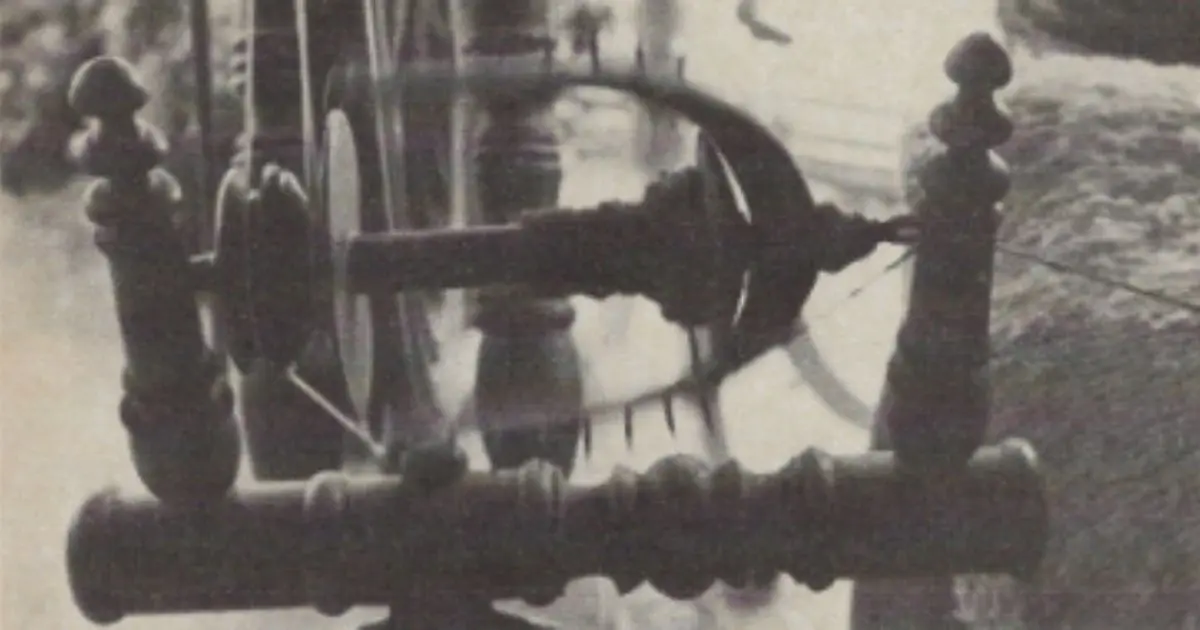
Spinning is essentially the technique used to twist short fibres into a longer, continuous thread. The fibres are drawn out and then a wheel twists them together and winds them onto a spindle. Hand spindles were used in very early times and introduced into Europe during the 14th century. Silk, cotton and wool were spun using this labourious technique. Gradually, refinements added, such as the distaf (a stick which bound the fibres in a position from which they could be drawn out to the required degree of fineness). By mounting the spindle horizontally, it was found that it could be rotated by a cord encircling
a large, hand-drawn wheel.
The spinning was not continuous, however, as it had to be stopped to wind the newly spun yarn onto a stick. Finally the Saxony wheel was developed in Europe in the 16th century. The addition of a flyer, which inserted the twist and was driven by a foot treadle, and the bobbin onto which the yarn was wound, meant that the wool could be spun without interruption.
This wheel, used in the home by spinsters, or the distaff side of the family in general, is essentially the same wheel used by hand spinners today.
First Steps
Shearing a sheep is an art in itself, and most small flock owners have it done by an old hand, who will work to shear the wool so that it comes off in a single piece. After shearing, the fleece is laid down and as much dirt and hay as possible picked out of the wool. It is then skirted, that is the edges are trimmed to remove dirt. Then weighed, and paid for, the spinner can take it home.
In choosing a fleece from a commercial source, Mrs. Jefers goes by her sense of touch. “I get a coarser one if it is for a rug, a softer one for knitting.” White fleeces are more easily obtained than coloured ones, but black sheep are gradually being reestablished to meet the demands of new spinners. A black fleece can vary considerably in its colour, and from a single sheep may range from yellow, grey, fawn, and brown to pure black.
A raw fleece ranges in weight from six to ten pounds, and costs about $1.50 a pound to buy, of which the farmer gets 80 cents (a man’s heavy sweater might take eight pounds of clean wool, and require more than one fleece). Cleaned and carded wool imported from New Zealand now sells for about $3.65 a pound, or for about $3.40 uncleaned.
On the other hand, as much as half the weight of an unprocessed fleece may be dirt and grease that is removed with cleaning, so the apparent cost advantage in buying a raw fleece may not be as great as it first seems.
Once home, there may be as many as five processes involved in spinning the wool, depending on how it is to be used. They may be done in varying order. Some weavers and knitters prefer the wool unwashed and left its natural colour. In this case the only step left before spinning the wool is to card it that is, to untangle the wool and separate the fibres.
Carders look like big, sway-backed, metal-pronged dog brushes, and a pair of leather-backed carders may cost $15. Used properly (catch a handful of wool between and pull the carders in opposite directions to remove lumps and get the fibres going in one direction), the carders turn the wool into long slivers ringlet shaped rolls of wool.
At this point the wool can be spun, or can be washed and dyed. Alternately, the fleece could have been washed and dyed before carding. In any case, as long as wool is to be dyed, it must be washed. Rain water is a good medium in which to wash it because it is soft and doesn’t contain troublesome lime and minerals which can attach to the wool. Spinners tend to wash raw wool in the same way they treat woollen garments, in everything from soda and soap suds to Woolite.

Natural Dyes
The first step in dyeing is to mordant the wool. The mordant makes the wool open up and grasp the dye, and a commonly used formula in this region is four ounces of alum and two ounces of cream of tartar in four gallons of water. This is enough to process one pound of wool in a good-sized preserving kettle.
Once washed and rinsed, the wool is moved to the mordant, which should be the same temperature as the rinse water. There it is brought to a simmer NEVER a boil and then kept at a simmer for about 30 minutes. Next it goes straight to the dye pot, again at the same temperature as the mordant bath.
(If it is not possible to dye at this point, the wool must be kept in the dark. Some spinners bundle it up in a plastic bag and store in the refrigerator or freezer. Others dry it quickly outside and then store it away in a dark cupboard until they are ready to dye it.)
Once in the dye pot, the wool must be brought to a simmer and held for 30 to 45 minutes until the colour is as dark as required. Remember, wool looks darker when wet. After rinsing, it can be dried; some non-purists have been known to do this by stuffing the wool into a pillowcase and tumbling it in a spin-dryer.
Enamel, stainless steel or glass pots can be used for dyeing, but should not be used afterwards for cooking. Iron pots are good for black walnut dyes (which make rich shades of brown), and an antique brass pot is perfect for onion dyes.
Just about anything that grows can be used to dye wool. Common dyes are made from golden rod, cofee, tea, Queen Anne’s lace, and even the rich purple pulp left over from the making of elderberry jam. Jewel weed picked early makes a red hue, picked later, a carmel one. Iris roots give varying results. “It’s supposed to produce purple,” says Mrs. Jefers, “but we’re never quite sure what we’ll get.”
Some insects, such as the red cochineal bug (obtainable dried from spinning suppliers) make a deep pink dye. Ann Botterell wears a dark yellow skirt made from wool she dyed with apple bark. She has also experimented with woad, an old dyeing plant she obtained from the Black Creek Pioneer Village north of Toronto. Woad makes a blue colour, while Lady’s Bedstraw produces a red one. Rhubarb stems past the eating stage make a lovely mauve.
Onion skins, which can be boiled to make a subtle yellow dye, can be peeled dry (do not use water) and stored for years. One pound is usually boiled in a quart of water for small batch dyeing.

The Spinning
Although a keen spinner, Mrs. Botterell is the first to admit that it’s a time-consuming business. “One skein of wool (three ounces) takes about four hours to spin,” she says. Also, unlike in weaving, the novice spinner must work to catch onto the technique. “Weaving is something you can watch, then copy for yourself,” says Ann. “You have to get spinning.”
However, she points out that a spinning wheel costs less than a loom, and a beginner can start with a simple spindle. According to Mrs. Jeffers, who has taught groups of up to 18 novices at a time, all you really need is a basic hand spindle which sells for several dollars at most spinning supply houses (see accompanying photo). You have to spin standing up, but it works and yarn has been spun this way for centuries.
In addition to wool, spinners can branch into cotton, silk and flax, which tends to be hard on the hands and more difficult to spin. It is very difficult to learn to spin from a book and the best approach is to seek out an experienced spinner for lessons.
Where there are weavers nowadays, there are bound to be a few spinners. They often meet in groups or workshops and bring in top spinners from other areas to teach them. Contacting one of these groups is sure to lead you into the swelling ranks of spinsters.

The first temptation of every hand spinner is probably to find an antique spinning wheel and put it back into use. Novices should be aware of two major drawbacks before investing in an old wheel, however aesthetically pleasing. The first is price, unless you happen upon a “find,” as antique wheels may run from $85 to more than $300.
Secondly, spinning wheels are very delicate creatures, and after lying for half a century splitting, warping and losing bits in an old attic or chicken coop, they are often dificult to put into working order. It is usually possible to restore them into show pieces, but to balance a wheel properly, even if parts can be duplicated, may be an impossibility. When considering the purchase of an old wheel, it is imperative that the novice spinner consult an experienced spinner.
If the wheel is broken, is there someone in the area who knows how to make a wooden wheel? Does he know how a spinning wheel works? In what state is the bobbin, the flyer, the whorl and the two maidens? The wheel has to balance and run and the cord has to be in line with the bobbin and flyer so it will work smoothly.
A good test is to see if the wheel I will make at least 10 turns without treadling it again. If it won’t, perhaps it just needs oiling and sanding down. Then again, it may just be too late to make it into a working wheel again.
New wheels are less risky to buy and are favored by many spinners who don’t want to cope with temperamental antique. Doreen Jefers uses an 80-year-old Quebec wheel, but recently succumbed to the enticements of a brand-new model. The one she chose is small, portable, versatile and tougher to break than an antique. It costs about $110 and comes from New Zealand in kit form, including complete instructions, a Lazy Kate and four bobbins. It is made by Ash-ford Handicrafts Ltd., Box 180,
Ashburton, New Zealand and is sold by a number of spinning. suppliers on this side of the Pacific.
Marion Hart, a spinning instructor at St. Lawrence College, Cornwall, likes the little Hebridean and Shetland wheels made by Haldane and Co., of Scotland. These range in price from $135 to $350.
A Canadian company known for their looms has recently begun to produce a spinning wheel. The Nilus LeClere Co., of L’Isletzille, Quebec, now makes a Saxony wheel, almost as large as the old Quebec wheel and selling for $138.
The Spinning Wheel Factory at R.R. 4, Milton, Ontario, turn out wheels for about $135, and there is a waiting list.
And then there is W.J. Robidoux, a rare and proud craftsman from Acton, Ontario. He makes spinning wheels by hand in his basement workshop. Using a variety of woods, he often copies antique wheels but occasionally uses his own designs. Robidoux wheels are considered works of art, cost well over $200, and most of them go south of the border.
Originally written by Gillian Sadinsky and published 50 years ago in 1976. Some info may be out of date.