

For guidance on reading the tables for beginners – please go here
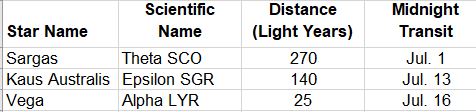
The summer sky lacks the eye-catching stars that we remember from winter. But for those who are able to travel out into the country, there is a special visual experience.
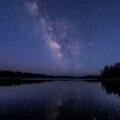
During the last half of the month, while the Moon is below the horizon, the Milky Way will roll out of the eastern sky. It arcs from the NE, overhead into the south. It provides a structure and order to the random distribution of stars. It divides the sky into the west with our view out into intergalactic space with space galactic gas and dust to dim our view. And to the east, down through the plane of our galaxy, through the other side into the universe. Under a dark sky we can see structure of dark dust lanes and star clouds when we look along the hazy plane of the Milky Wall.. Less than an hour of observing will whet our appetite to see more.
As the month ends, Mars is drifting into Virgo, and the thin crescent Moon glides between it and the western horizon just after sunset on the 28th.
NOTABLE EVENTS
2 1st quarter Moon
3 Sun at Aphelion (152 million km)
4 Mercury at greatest morning elongation
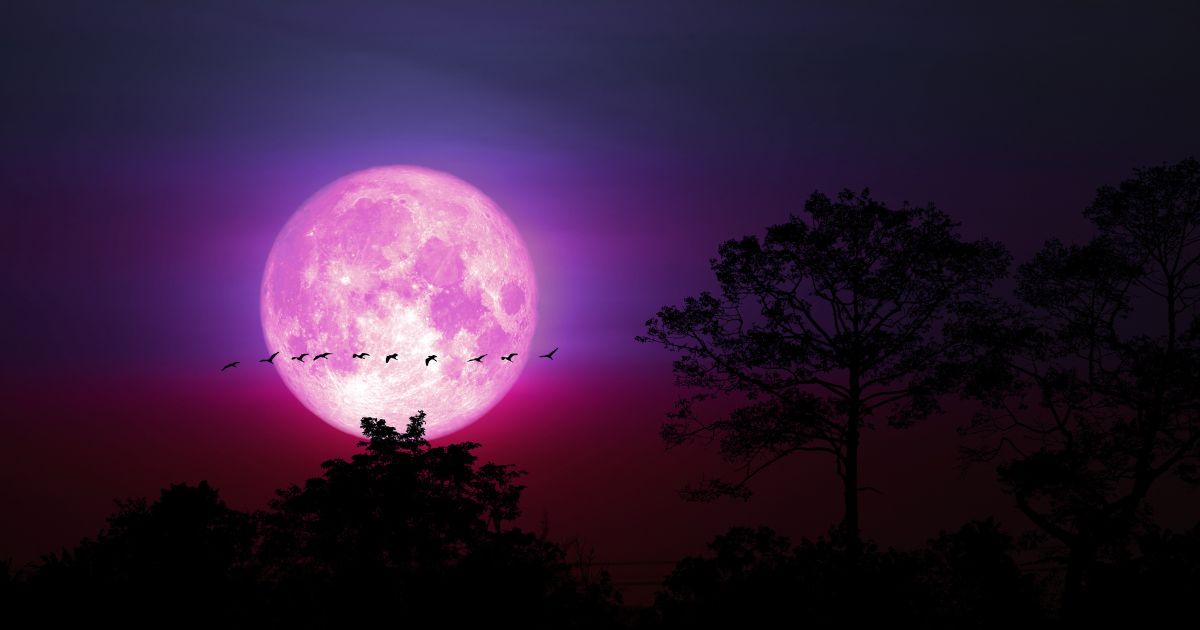
10 Full Moon
17 Last Quarter Moon
20 Sun enters Cancer
24 New Moon
MONTHLY TABLE
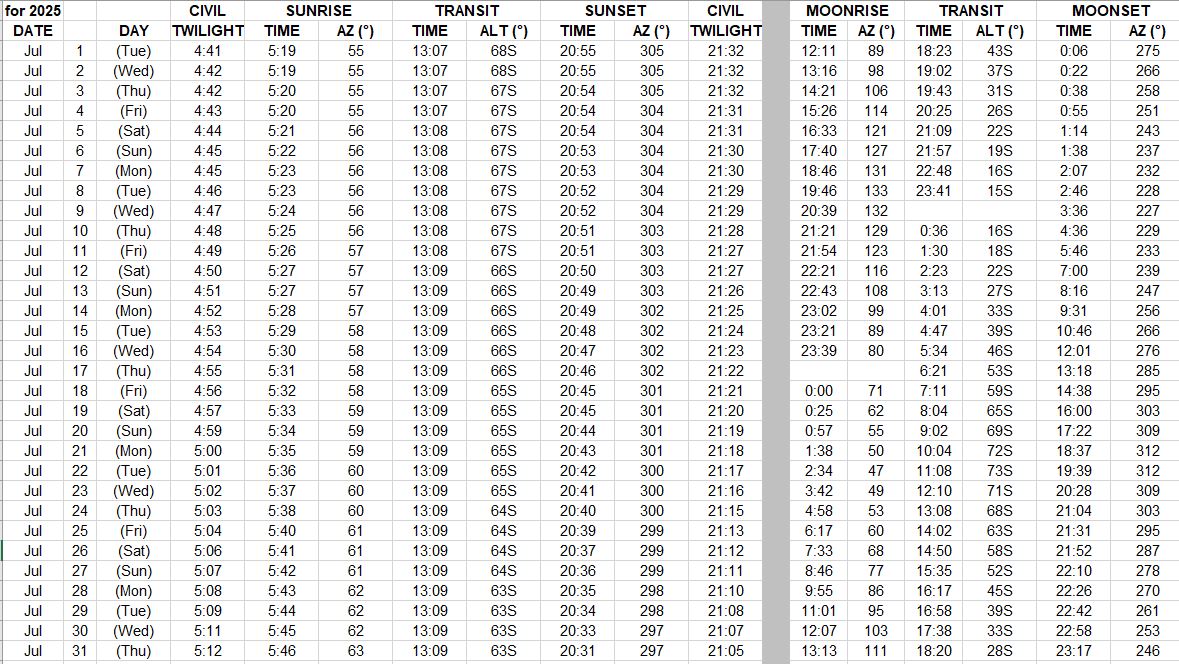
Dates for the Phases of the Moon

Entries are in Eastern Time and only require time zone correction. Do not use the correction from the “Ottawa-Time” table. Saskatchewan and parts of BC and Ontario do not use daylight savings. In these regions, subtract 1-hour from these times from March 10 to November 3.
Planetary Configurations
When at Opposition, planets will appear on the opposite side of the sky from the Sun – very roughly on the meridian at midnight. Conjunctions are when the planet has the same “longitude” as the Sun. A Superior Conjunction is when the planet is on the other side of the Sun, and an Inferior Conjunction is when it is between the Earth and the Sun. Only Mercury and Venus can be at Inferior Conjunction. Maximum elongation is when Mercury and Venus appear farthest from the Sun in our sky. This occurs either in our morning eastern sky (mor.) or our western evening sky (eve.). Do not apply the Ottawa-correction times to the times in this table.


Prominent Constellations by Seasons

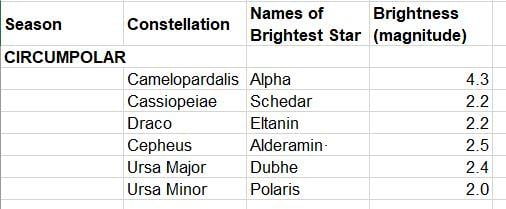
Brightest Stars