

For guidance on reading the tables for beginners – please go here
The official beginning of summer is at 22:42 on June 20 as the Sun appears to cross the celestial equator into the northern hemisphere. There is no guarantee it will be warm and sunny, but it will be the longest day (and shortest night) of the year. Mars is the only planet in our evening sky. It is slowly moving eastward through Leo towards its brightest star Regulus. It will pass above of it within 3/4° on the 17th.
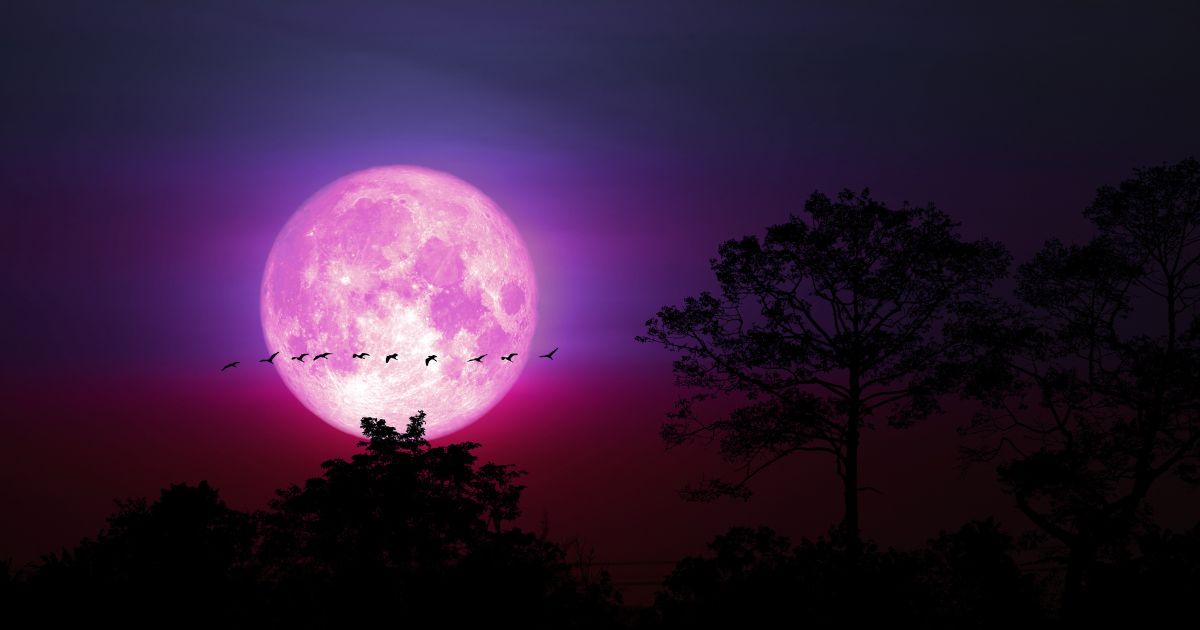
The full Moon is during the night of the 11th. We expect the full moon to light up the countryside throughout the night, but not this time!
The Moon roughly follows the ecliptic around our sky. The ecliptic is the path the Sun appears to follow around our sky. The ecliptic is high in the winter sky and very low in the summer sky. The July full Moon is an additional 5° below the ecliptic; so it will cross the sky very low in the south. This is good for stargazers because it will rise late and set early, but no so good for walks across the countryside.
NOTABLE EVENTS:
NOTABLE EVENTS
Jun 2 1st quarter Moon
Jun 11 Full Moon
Jun 18 Last Quarter Moon
Jun 20 Summer Solstice at 22:42
Jun 21 Sun enters Gemini
Jun 25 New Moon
MONTHLY TABLE:
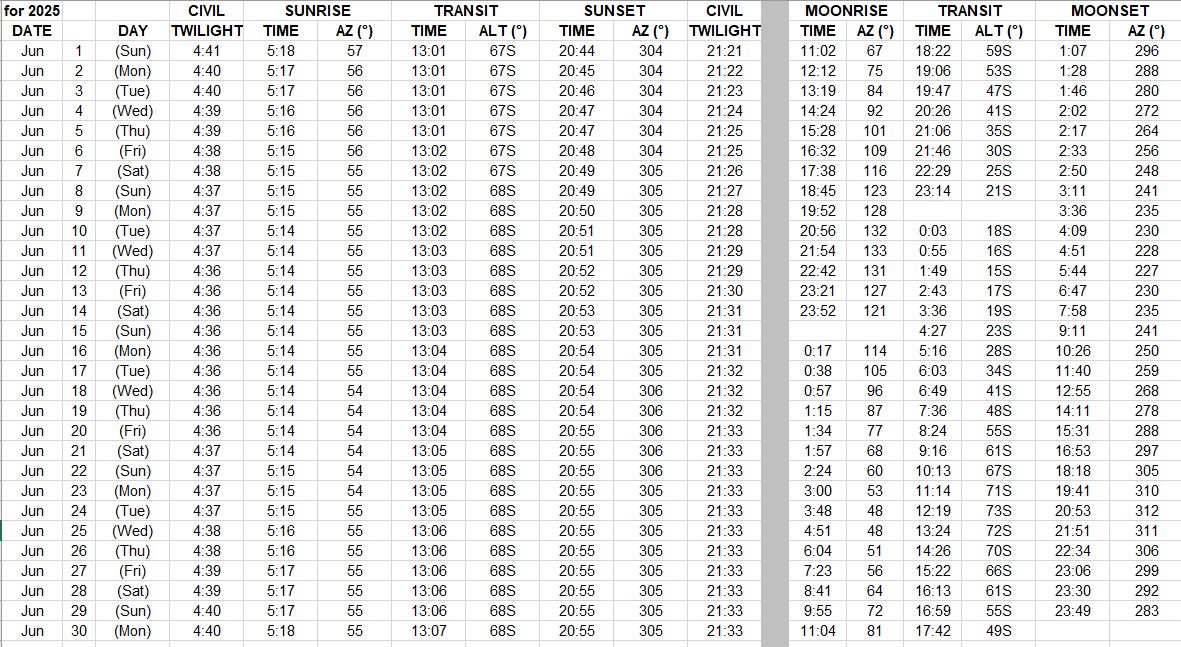
Dates for the Phases of the Moon

Entries are in Eastern Time and only require time zone correction. Do not use the correction from the “Ottawa-Time” table. Saskatchewan and parts of BC and Ontario do not use daylight savings. In these regions, subtract 1-hour from these times from March 10 to November 3.
Planetary Configurations
When at Opposition, planets will appear on the opposite side of the sky from the Sun – very roughly on the meridian at midnight. Conjunctions are when the planet has the same “longitude” as the Sun. A Superior Conjunction is when the planet is on the other side of the Sun, and an Inferior Conjunction is when it is between the Earth and the Sun. Only Mercury and Venus can be at Inferior Conjunction. Maximum elongation is when Mercury and Venus appear farthest from the Sun in our sky. This occurs either in our morning eastern sky (mor.) or our western evening sky (eve.). Do not apply the Ottawa-correction times to the times in this table.


Prominent Constellations by Seasons
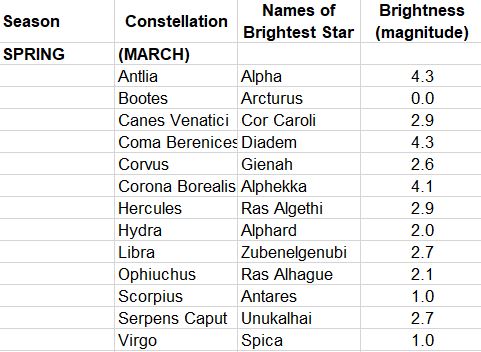

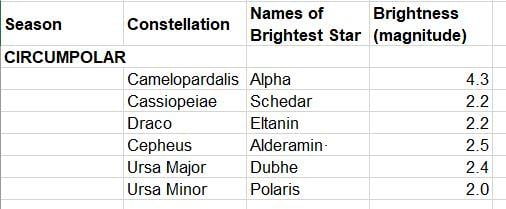
Brightest Stars