
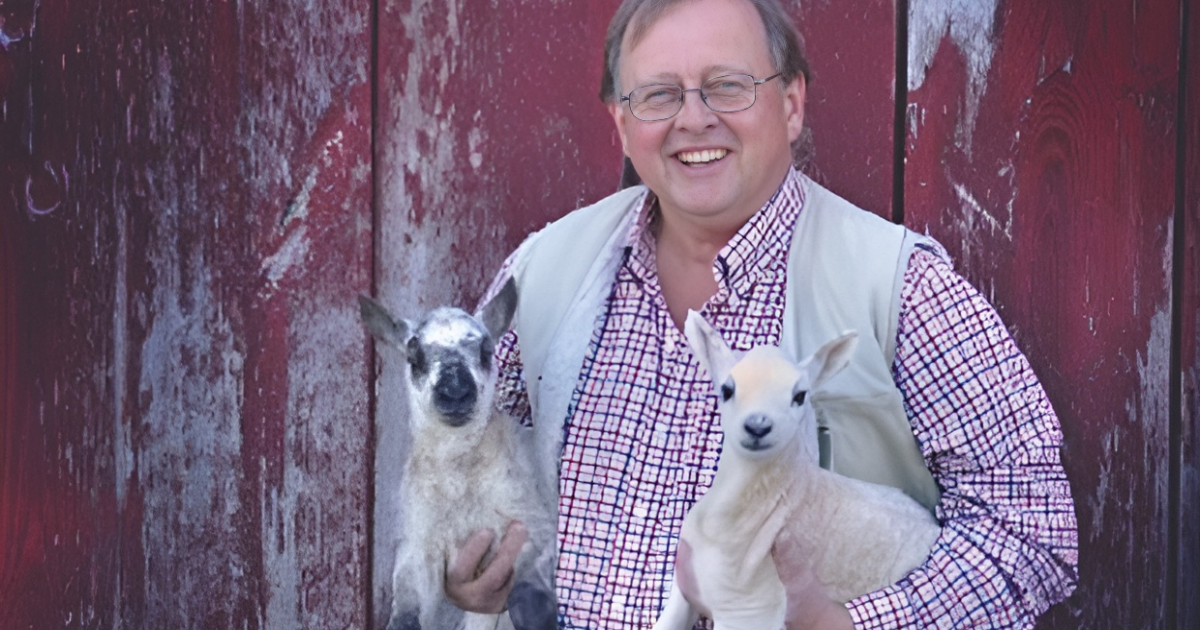
Dan Needles, author/playwright of the popular Wingfield Farm series and contributor to Harrowsmith magazine from 1997 to 2011, chats about his newest book, and why he finds country life so darn funny.
I have a few things in common with Dan Needles: We grew up a few streets apart in Toronto; we graduated the same year from the same high school; and later we gravitated to country life. His influences were much different from mine but nonetheless…an attraction to rural life has led to decades in the country for both of us.
Dan grew up in a family connected to the arts, finance and business. He has worked in publishing and insurance and even served beer in a pub (another thing we have in common). With a degree in economics and an inspiring upbringing in rural Ontario, he sought out a farming life in his thirties but his finest work is his writing. Nominated three times for the Leacock Medal, he won it in 2003.
Late last year, when his newest book was released, my interview partner, Madeleine Hague, and I were pleased to chat with Dan at his Larkspur Farm home.
Michael Schultz & Madeleine Hague: Tell us more about the title: Larkspur: A Return to Village Life.
Dan Needles: Larkspur is the town at the centre of Persephone Township in the Wingfield plays. It’s a fictional place, the place that Walt Wingfield discovers when he leaves Toronto and buys the farm. Larkspur has a lot of connections for me. I used to grow larkspur in the garden at the farm in Rosemont where I grew up and George Bain wrote a column in the Globe & Mail called “Letters from Lilac” and I thought I’d do “Letters from Larkspur.” I was told by my English professor, “Don’t use the first person, don’t use the epistolary format, don’t write letters.” I disobeyed all the rules that my English teacher gave me and the rest is history.
Michael Schultz & Madeleine Hague: With your upbringing being city and rural-based, can you tell us about how that has affected your writing and life later on – certainly when you sought out Larkspur Farm?
Dan Needles: I was reminded of this yesterday, speaking to my old audience in Shelburne about my first job out of university. I was the editor of the weekly newspaper there. And I got beaten about the head and shoulders frequently, by people who were in the same lineup in the grocery store; the same people I was writing about in the newspaper. I learned to be careful. You’re not anonymous. You’ve got to use some discretion in your search for the truth. So, I learned early on to balance the truth with affection. And the pill goes down a lot easier with a spoonful of sugar, a.k.a. humour. I grew up with writers like Alice Munro. My mother, among other things, edited the CBC series “Short Stories with John Drainie” and Alice Munro was one of the regular contributors to that, so I read her short stories on the floor of my mother’s study in the late ‘50s, early ‘60s.

Michael Schultz & Madeleine Hague: Do you have a particular writing regimen? Time of day? A certain space?
Dan Needles: I always feel like I should be at the desk. I do the chores in the morning, then I come and sit at the desk and I do correspondence. If I have a deadline, I just put the project in front of me, put it up on the screen and before you know it, you’re into it. The thing I tell my students is talent is a wonderful thing and we should never overlook the value of talent, but the habit of doing this is probably more important.
Just the habit of writing. If you don’t have the habit, you’re going to find this very difficult. And I developed a habit when I was about nine. My mother said, “This is a world that is slipping away. You should pay attention to it.” And I started writing; well not so much writing but composing stories in my head. I went to a tough school and I found if people were laughing they were much less likely to punch you.
Michael Schultz & Madeleine Hague: You wrote for Harrowsmith magazine for 25 years. Any reflections about your time with the publication?
Dan Needles: Tom Cruickshank drafted me. I took over from Timothy Findley who was an old buddy of my father’s. I presume that Findley put in a good word for me with Tom but years later Tom said, “I never had a conversation with Findley.”
Harrowsmith expanded my reach–it’s a national magazine and I found a connection with small farmers all over the place that I hadn’t been able to reach with the Wingfield plays; some places that Rod (Beattie) was not going to. But Harrowsmith seemed to go everywhere. I got a lot of correspondence and invitations from far-flung areas and it reminded me that even though my own rural neighbourhood had metamorphosed into something else, the small farm was still alive and well in many parts of the country.

Michael Schultz & Madeleine Hague: With the influx of new people to small towns and rural areas what other trends do you see? Are there trends that you would like to see?
Dan Needles: Rural life for the first 200 years of settlement was based on agriculture and now that’s a tiny fraction of peoples’ occupations in rural Canada. It’s like, one percent of the population are farmers and even less than that are doing it for a living. Most farms in Ontario are run by hobbyists, in other words, people who have jobs doing something else.
There’s only about 800 pig farms, the same number of dairy farms; it’s a very small number of people who are actually making a living out of agriculture. And yet, the production is higher than it’s ever been in our history. It’s just so intensive. So, the sideroad is now dotted with all sorts of other occupations. It’s not just a place where people come to relax, especially since the pandemic.
The home office that I pioneered in the 1980’s has now become commonplace. Nobody believed you could do it. When I left the insurance company there was a huge amount of skepticism including from my own father. He said, “You’ve got a good job. What are you doing? Farming? You’ve got to do something that makes money.”
Farming isn’t something everybody likes to do. When I grew up, there were lots of people who had no aptitude whatsoever and they were unhappily stuck on the back roads. They really couldn’t wait to take the first bus out and do something different. So, it’s not an occupation that appeals to everyone. I just happen to like growing stuff. I like feeding stuff to animals first and foremost. That is my “love language.” So I have chickens that follow me around, I have one sheep that is completely devoted to me, two cows that come galloping up to meet me every time I go into the pasture. I bond with animals through food and that’s how I bonded with my children as well. I think it brings out the best in you, when you look after “stuff.” And that’s how you develop affection for people and animals and places…practising stewardship.
I have a biblical quote over my desk here: “Like good stewards of the manifold grace of God serve one another with whatever gift each of you has received” —First Peter
It came from a politician I worked with who was really brilliant at identifying the gifts that people had around him. I liked the way that community looked after each other. If there’s one thing I’d like the community to return to, it’s a wider practice of looking after each other. Calgary Mayor Naheed Nenshi during the Alberta floods, invited people down to a mass gathering in the stadium to start a volunteer effort to look after people and there was some hiccup in the sound system and they couldn’t really get organized on stage, and he just took the microphone and said, “You know what to do. Go back to your neighbourhoods.
You know what needs to be done. Go and do it.” And the lawyers around him had a fit. But Calgary did just that. And they got through the flood in very good order because that instinct, that civility, that sense of a commonwealth is still alive and well in Calgary.

Michael Schultz & Madeleine Hague: You write a lot about everyday people. What about penning a biography about a prominent Canadian?
Dan Needles: I’m not an academic. When you do history, you do have to be precise about the facts. My training and my instincts are not that precise. I’m kind of a lateral thinker, not someone you’d put on the “ways and means committee.” And, I’m a little too free with my opinions. I play with things, that’s the problem.
Rapid Round:
Q: The best part of country living is ?
A: You have all the amusement you require within 300 yards.
Q: Name your favourite farm implement:
A: I have a manure spreader that was built in 1958 and I have taken it apart and put it back together any number of times. I’ve actually had it one year longer than the dairy farmer I bought it from, so I think it’s 41 years old now.
Q: What’s the best advice a farmer ever gave you?
A: Hughie, my next door neighbour, was watching me do a cost-benefit analysis on the sheep. I am trained as an economist and he said, “Danny, stop trying to justify what you’re doing with that calculator. Put that thing away before you hurt yourself. The fact is, you keep sheep because you like them. That’s the only reason you have to give me for anything that you do.”
Hughie died about eight years ago at age 72. I spoke to Hughie more often than anyone else except my wife. We lived beside each other for 35 years.