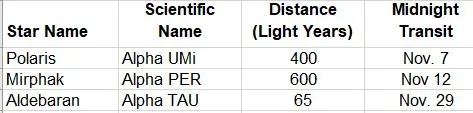


For guidance on reading the tables for beginners – please go here
We revert back to standard time at 2am on November 2. What we lose in evening sunlight, we gain with and earlier dawn.
The sky darkens earlier as the weeks go by. Normally, the stars will appear further to the west each evening. But in the autumn, people on their habitual evening walkabouts who set out when sky is dark (rather than a particular time) will experience the sky “standing still”. The earlier darkening compensates for the westward movement of the sky. This makes the summer stars seem to hover in the western sky all through autumn.
NOTABLE EVENTS
Nov 2 Standard Time begins at 2am local time
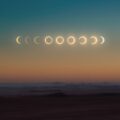
Nov 5 Full Moon
Nov 12 Last Quarter Moon
Nov 20 New Moon
Nov 23 Sun enters Scorpius
Nov 28 1st quarter Moon
Nov 29 Sun enters Ophiuchus
MONTHLY TABLE
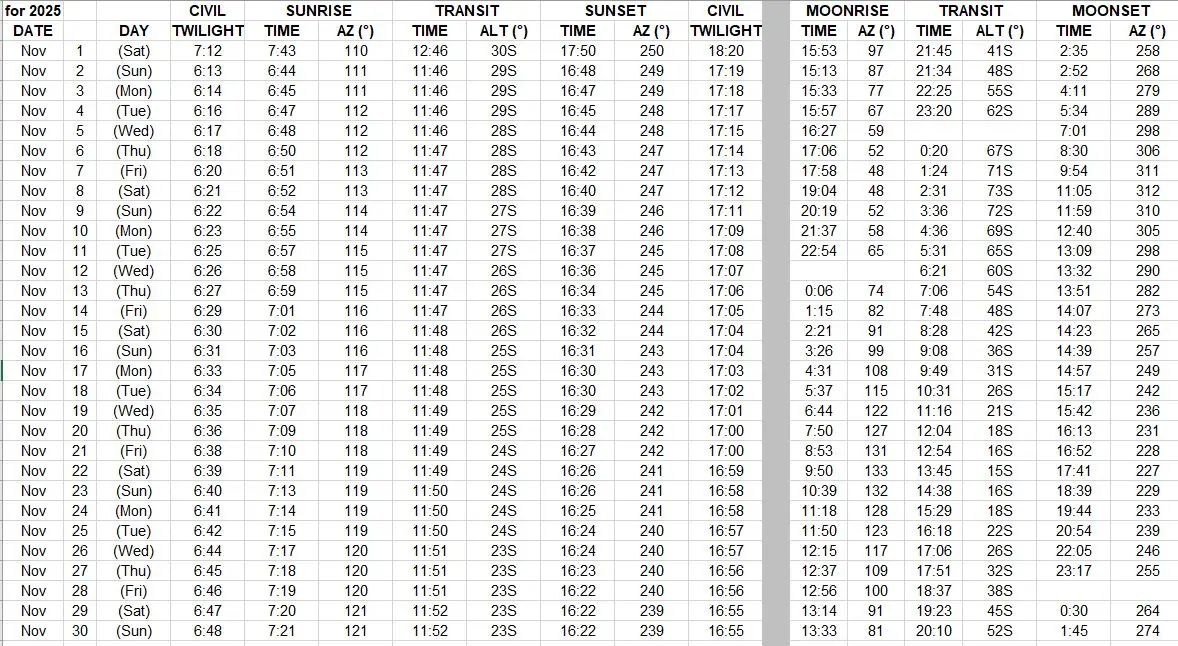
Dates for the Phases of the Moon

Entries are in Eastern Time and only require time zone correction. Do not use the correction from the “Ottawa-Time” table. Saskatchewan and parts of BC and Ontario do not use daylight savings. In these regions, subtract 1-hour from these times from March 10 to November 3.
Planetary Configurations
When at Opposition, planets will appear on the opposite side of the sky from the Sun – very roughly on the meridian at midnight. Conjunctions are when the planet has the same “longitude” as the Sun. A Superior Conjunction is when the planet is on the other side of the Sun, and an Inferior Conjunction is when it is between the Earth and the Sun. Only Mercury and Venus can be at Inferior Conjunction. Maximum elongation is when Mercury and Venus appear farthest from the Sun in our sky. This occurs either in our morning eastern sky (mor.) or our western evening sky (eve.). Do not apply the Ottawa-correction times to the times in this table.


Prominent Constellations by Seasons

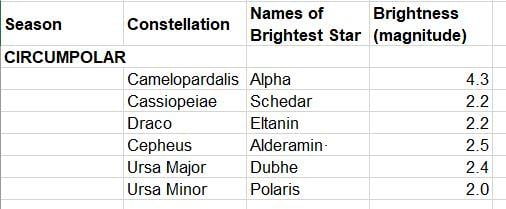
Brightest Stars