
For guidance on reading the tables for beginners – please go here
The night is getting sufficiently dark at mid-month to start observing at 8 pm.
One attraction for stargazers is knowing what lies just beyond the veil of darkness and the challenge of glimpsing these hidden treasures. In many cases only binoculars are needed to pierce this threshold.
In September we could use Saturn to help us locate Neptune in a telescope. Uranus is much brighter but it’s still a challenge. In the middle of October, Uranus (magnitude 5.6) rises about 8pm and is well place for observation a couple of hours later. But it is only 1/100 as bright as Saturn. You will find it about 5° SSE of the Pleiades star cluster in the constellation Taurus. It will be the brightest “star” in your binocular field of view and may appear slightly bluish “star”. You will need a telescope to see its disk.
NOTABLE EVENTS
5 Saturn 2.8° south of the near-full Moon
6 Full Moon
13 Last Quarter Moon
21 New Moon
29 1st quarter Moon, Mercury at greatest morning elongation
31 Sun enters Libra
MONTHLY TABLE

We list Ottawa times (Daylight Saving) to align with the general practice of referencing events to the Nation’s capital.
Dates for the Phases of the Moon

Entries are in Eastern Time and only require time zone correction. Do not use the correction from the “Ottawa-Time” table. Saskatchewan and parts of BC and Ontario do not use daylight savings. In these regions, subtract 1-hour from these times from March 10 to November 3.
Planetary Configurations
When at Opposition, planets will appear on the opposite side of the sky from the Sun – very roughly on the meridian at midnight. Conjunctions are when the planet has the same “longitude” as the Sun. A Superior Conjunction is when the planet is on the other side of the Sun, and an Inferior Conjunction is when it is between the Earth and the Sun. Only Mercury and Venus can be at Inferior Conjunction. Maximum elongation is when Mercury and Venus appear farthest from the Sun in our sky. This occurs either in our morning eastern sky (mor.) or our western evening sky (eve.). Do not apply the Ottawa-correction times to the times in this table.


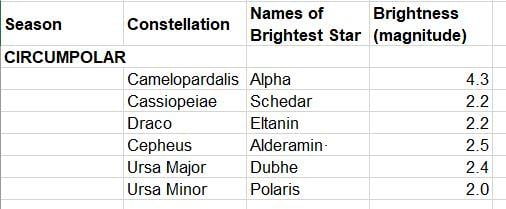
Prominent Constellations by Seasons