
This article was written 50 years ago. Some info may be outdated Written by William Hutchison in 1976 – Issue #1
It’s the first day of spring in suburban Mississauga, but young boys, well bundled, continue to play street hockey and the temperature hovers near the freezing point. Despite the lingering Canadian winter, 2940 Quetta Mews has been running almost completely on solar heat for nearly a month.
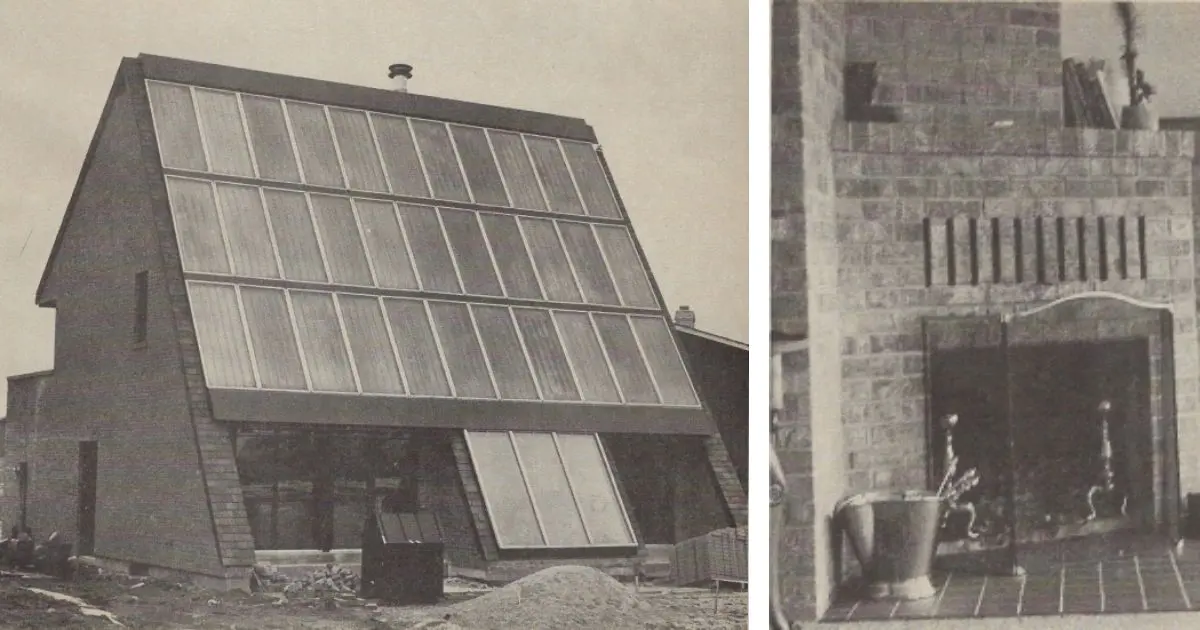
From the street, the two-storey brick house blends easily with its conventional $60,000 neighbours. Only from the rear is its secret given away. Thirty-three solar collectors glitter darkly from the back roof, promising that 60 to 70 per cent of this home’s annual heating energy will come from the sun, not Ontario Hydro.

Douglas and Donna Lorriman, occupants, experimenters and live-in guinea pigs, find Number 2940 a comfortable, sophisticated home. If anything, the $140,000 computer-designed experimental house has proved too warm at times once rising to 92 in the living room on a sunny mid-winter day.
While the Lorrimans are cautiously enthusiastic about the house, they point out that many questions remain to be answered.
Can solar heating be packaged so as not to frighten off the conservative buyer? Will the home’s many heat-saving modifications prove liveable? Will the solar system actually be able to meet 70 per cent of the home’s needs in the face of sub-zero (Fahrenheit) winter weather?
A recent Saturday afternoon visit with the Lorrimans found them relaxing between the work week and Sunday, when they ofer tours of the house to the curious. Donna has just turned on the dishwasher the noisiest piece of machinery in exceptionally quiet house. Natasha, the family’s white Samoyed and probably the only dog in North American with a solar designed dog house, cruises the living room begging apple cores from the mid-afternoon snack.
Doug, a graduate architect, leans back on the living room couch, stacks one slippered foot on top of the other and delivers a verbal curve to the visitors. “The main thrust of the experiment is to reduce energy demand, not to build a totally solar heated house,” he says.
Built entirely from off-the-shelf components readily available to the public, the Mississauga house could conceivably serve as a model for mass production in the near future. Nevertheless, the Lorrimans warn that solar heating today remains within the province of the experimenters, the do-it-yourselfers and the fanatics. They expect the technology in their home to be made obsolete within three to four years.

Nevertheless, Lorriman is emphatic about what can be done by new home builders right now, and claims that a correctly designed and positioned house can have a 1,200 mile climatic advantage over a conventional neighbour. In the summer, a well-thought-out home will operate as if it were 600 miles to the north, he says, while in winter it will act as if 600 miles closer to the equator.
Doug suggests that a house can be built now with provision for adding a solar system in the future. He is definite about the less glamourous ways of handling heat and cold that can easily be taken advantage of today. The first of these is site sensitivity or “knowing where the hell you are,” says Lorriman. “You can’t just plunk down a floor plan on your building site.” He says the house should be located with more in mind than its relationship with the street and the view. It should take advantage of the sun by having main windows opening to southern light, while trees can be used to advantage to provide summer shade and winter wind protection.
In the Mississauga solar house the southern ground floor wall is all glass, opening onto the backyard and the strongest rays of the sun, giving free light and heat to the living room, dining room and a small greenhouse. Visitors to the house have noticed its soft, relatively dim light, attributed to the minimum window space in the north, east and west walls. The stairwell and closets which need little heat or window space are located on the north side of the house, together with the heat-producing kitchen.
Lorriman recommends as much insulation as practical- the equivalent of six inches of fibreglass in the walls and eight inches or more between ceiling and roof where the heat loss is highest. Air leaking through the walls can cause a greater loss of heat than mere conduction through the same walls, and this should be blocked by installing polyethylene or foil sheeting on the inside of the insulation. Windows are sealed with durable weatherstripping.
Doors used during the winter at the Mississauga house are “air-locked” so that no direct opening to the outdoors exists. The front entry has an inner vestibule, and the side door opens into the garage. Patio doors form part of the rear glass wall and are reserved for summer use. Lorriman warns that homes as tightly sealed as this must have an air feed from the outside to oil or gas furnaces so that the open flame does not use the oxygen in the home.
The solar house has a number of additional minor energy saving conserving touches. In the winter, air from the electric clothes dryer is vented into the heating system to add warm, moist air with just a slight aroma of fleecy. Hot air from the kitchen stove passes through a filter and is kept indoors. Walls are painted a highly reflective white to reduce the need for artificial lighting.
The Lorrimans give their new home bad marks on only two points. The front door vestibule is too small, and the bathroom too dark. Usually one of the hottest rooms in a house, the bathroom in this case was built at the centre of the solar home so that the extra heat would be radiated to other rooms, not lost to the outside. Both Donna and Doug miss the traditional window to the outside.
In short, the home is designed to contain every possible BTU from its solar heat source. The heating system itself is relatively straightforward, with two main subsystems the rooftop solar collectors and two hot water storage tanks in the basement. The water is pumped upward through the 690 square feet of solar collecting panels that cover the sharply angled rear roof of the home, and the heated water then returns to the first of the two 2,500 gallon holding tanks.
When the temperature of the water in the storage tanks exceeds 115° (F), it circulates in a direct heating coil which warms the air in a conventional forced air heating system (see diagram below).

When the temperature of the water dips below 115″, a conventional heat pump cuts in to extract heat from the warm water and convert it to warm air. An electric heating unit acts as a back-up to keep the house warm when the solar system cannot do it alone.
The 33 solar panels measure three feet by seven feet each and cost just over $200 a piece when purchased from Sunworks, Inc. of Connecticut. An adjustable heat sensing mechanism starts water pumping through the blackened copper tubing whenever the collector temperature is 10 degrees above that of the water in the cooler storage tank. The storage tanks themselves are made of concrete, poured in place when the foundation was laid. They sit in a corner of the cellar with about half their 10-foot height showing above the floor basement.
The system began operation this winter with cold (45-50°) municipal water in its tanks. In January, the roof collectors began warming the water, and, by the end of February, it was up to 104°. By this time the heat pump, which is efective in water temperatures as low as 60°, had taken over from the stand-by electrical heater. The collectors wil remain in operation over the summer, and Doug plans to have the tanks as hot as possible for a running start into next winter.
More than technology is involved in this experiment in the Meadow-vale subdivision northwest Toronto. “What we have tried to do is actually more a question on context than design,” says Lorriman. The home was deliberately built in among standard subdivision houses, where it would have to meet definite architectural and public acceptability standards.
Donna describes their construction struggles as “mind-boggling” having to argue with contractors looking for special prices for regular work on a special house, and wrestling with government regulations, inspections and tax assessments. So far, there has been no adverse reaction from the neighbours, and upwards of 150 visitors have given either approving or non-committall responses. Doug worries that their face-to-face politeness may be colouring their reactions to the unusual house and preventing criticism.
In some ways, the Lorrimans feel stranded in the subdivision. Theirs is the only one-car garage on the street, and they say their future may be aimed in the “back-to-the-earth” direction. Doug says he is apprehensive of and even has reservations about the amount of science used in this house. He is unsure of where the solar house project will take him professionally – perhaps in a role as a designer or consultant but would like to see common sense prevail over technology.
As their neighbours’ furnaces continued to burn in the late winter and early spring, the Lorriman’s experiment seemed well on the way toward their overall goal of “conserving fossil fuels and increasing the use of renewable resources. “We’re paying for previous generations’ lack of foresight,” says Lorriman. “Our children and grandchildren aren’t going to have anything to live on. We have to replace haste and waste with a little bit of common sense.”

Solar Factsheet
- HOUSE: Two-storey. 1,450 square feet (excluding basement), with three bedrooms and two bathrooms.
- COLLECTORS: Thirty-three flat plate panels, with 690 square feet (gross), each panel three feet by seven feet. Bought from Sunworks. Inc. of Connecticut, at $204, with 20 per cent Canadian Customs duty and a five per cent Federal sales tax added.
Heat pump (“Singer Heat Pump”) from Remington Air Conditioning of Canada, Ltd.
The panels are covered with tempered glass and backed by copper plates and tubing. They use tap water as a heat collecting medium and drain automatically to prevent freezing. - COST: Entire house construction cost close to $140,000, with $60,000 in government grants.
The solar heating system itself is estimated to have cost between $20,000 and $25,000.
Designers say the total high cost is attributable to the use of commercial contractors and off-the-shelf equipment, and the inclusion of special testing equipment to monitor the system. - RECORD: With no heating drain, panels warmed storage water from less than 50° (F) to 104° degrees between mid-January and the end of February.
With outdoor temperatures averaging 32° to 36° (F), the system had worked for six weeks without the electric back-up element. - OWNERS: Mississauga Solar Demonstration Project, Ltd., whose principals are Douglas Lorriman, apprentice architect, Blair Fergusson, engineering economist, and Douglas Lee, architect.
- TOURS: Sunday tours and further information available from:
Meadowvale Information Pavilion
P.O. Box 70, Meadowvale
Mississauga, Ontario
Telephone: (416) 826-1032
William Hutchison was a reporter for The Kingston Whig-Standard, who reported regularly for Harrowsmith on alternative energy topics.
Originally published 50 years ago in 1976. Some information may be out of date.