
For guidance on reading the tables for beginners – please go here
NOTABLE EVENTS
Mar 3 Full Moon, Lunar Eclipse
Mar 8 Daylight Saving begins at 2am local time
Mar 10 Moon at Apogee 404,356 km
Mar 11 Last Quarter Moon
Mar 12 Sun Enters Pisces
Mar 18 New Moon
Mar 20 Spring Equinox at 10:46
Mar 22 Moon at Perigee 366 879 km
Mar 25 1st quarter Moon
MONTHLY TABLE

ECLIPSES:
This is a great year for eclipses with a faint and prominent lunar pair, and a memorable solar eclipse. The solar eclipse will be visible over most of North America, but only a small portion will see the total eclipse spectacle. The rest of the continent will see only a portion of the. Sun covered by the Moon. Therefore we will leave a more detailed discussion for another article in this chapter.
We list Ottawa times (Daylight Saving) to align with the general practice of referencing events to the Nation’s capital.
The first lunar eclipse on the early morning of March 25 is the full Moon that preceeds the solar eclipse about two weeks later. It skirts the Moon – not making it into the dark umbral shaddow. If we were to stand on the Moon during this eclipse, we would still see a portion of the Sun shining beyond the dark disk of the Earth. This is called a penubral eclipse and it may only be noticeble with careful study. Visit www.timeanddate.com/eclipse/lunar/2024-march-25 for more information and diagrams.
The September 17-18 lunar eclipse will be be more evident, but it will still need careful observations. The lunar eclipse will not be as prominent as those in previous years. The Moon will only graze the dark umbra with a 3.5% coverage during mid eclipse. Visit www.timeanddate.com/eclipse/lunar/2024-september-18 for more information and diagrams.
Since lunar eclipses are visible from anywhere the Moon is above the horizon, you only need to correct the times for the difference of your time zone from EDT. Then you need to hope for clear skies.

Dates for the Phases of the Moon

Entries are in Eastern Time and only require time zone correction. Do not use the correction from the “Ottawa-Time” table. Saskatchewan and parts of BC and Ontario do not use daylight savings. In these regions, subtract 1-hour from these times from March 10 to November 3.
Planetary Configurations
When at Opposition, planets will appear on the opposite side of the sky from the Sun – very roughly on the meridian at midnight. Conjunctions are when the planet has the same “longitude” as the Sun. A Superior Conjunction is when the planet is on the other side of the Sun, and an Inferior Conjunction is when it is between the Earth and the Sun. Only Mercury and Venus can be at Inferior Conjunction. Maximum elongation is when Mercury and Venus appear farthest from the Sun in our sky. This occurs either in our morning eastern sky (mor.) or our western evening sky (eve.). Do not apply the Ottawa-correction times to the times in this table.

Prominent Constellations by Seasons

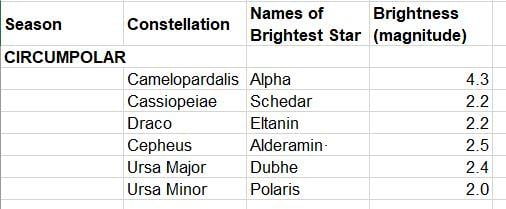
Brightest Stars