
For guidance on reading the tables for beginners – please go here
NOTABLE EVENTS
Feb 1 Full Moon
Feb 9 Last Quarter Moon
Feb 10 Moon at Apogee 404 549 km
Feb 14 Orion’s Belt and Scabbard on Meridean at 10pm
Feb 16 Sun enters Aquarius
Feb 17 New Moon
Feb 19 Mercury Max. Elongation (eve.)
Feb 23 Moon drifting by northern edge of Pleaides Cluster
Feb 24 1st quarter Moon, Moon at Perigee 370,145 km
MONTHLY TABLE:

Dates for the Phases of the Moon

Entries are in Eastern Time and only require time zone correction. Do not use the correction from the “Ottawa-Time” table. Saskatchewan and parts of BC and Ontario do not use daylight savings. In these regions, subtract 1-hour from these times from March 10 to November 3.
Planetary Configurations
When at Opposition, planets will appear on the opposite side of the sky from the Sun – very roughly on the meridian at midnight. Conjunctions are when the planet has the same “longitude” as the Sun. A Superior Conjunction is when the planet is on the other side of the Sun, and an Inferior Conjunction is when it is between the Earth and the Sun. Only Mercury and Venus can be at Inferior Conjunction. Maximum elongation is when Mercury and Venus appear farthest from the Sun in our sky. This occurs either in our morning eastern sky (mor.) or our western evening sky (eve.). Do not apply the Ottawa-correction times to the times in this table.

Prominent Constellations by Seasons

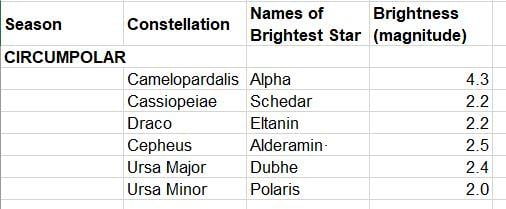
Brightest Stars