

For guidance on reading the tables for beginners – please go here
It is still fairly close to the winter solstice, so the evenings darken early allowing stargazing before dinner. The month begins with a near-full Moon in the east, which will compromise the visibility of the Quadrantid meteor shower that is centred on the night of January 3/4. These meteors will radiant from an area about 15-deg east of the Big Dipper’s handle.
Saturn is about 40-deg high in the south and Jupiter is visible rising in the east. Jupiter will be getting progressively higher through the winter and spring seasons as Saturn drifts more slowly towards the SW horizon.
An interesting binocular view is to see the Moon in the same field of view as the Pleiades star cluster. The Moon passes within a binocular field on January 27 and February 23. Since the Moon is much brighter than the stars of the Pleiades, you may have to look carefully to see them.
NOTABLE EVENTS
1 Moon at Perigee 360,385 km
3 Full Moon, Quadrantids Meteor Shower, Earth at Perihelion (closest to the sun) @ 147 million km
6 1st quarter Moon
10 Last Quarter Moon, Jupiter at Opposition
13 Moon at Apogee 405,413 km
18 New Moon
19 Sun enters Capricornus
25 1st quarter Moon
29 Moon at Perigee 365,895 km
MONTHLY TABLE

Main Meteor Showers
Meteor showers are best observed after midnight when Earth’s leading hemisphere is ploughing into the meteor stream. Although the duration of the most active portion of the shower is short, some shower meteors can be seen many days on either side of maximum.
There are about a dozen significant meteor showers each year. This is a list of only the three major ones that have different “characteristics”.
The Quadrantids radiate from an area 15-degrees east of the Big Dipper’s handle. The short duration for the shower is somewhat balanced by the possibility of bright “fire balls”. This is an un-favourable year for the Quadrantids as the full Moon will “washout” the fainter meteors.

Dates for the Phases of the Moon

Entries are in Eastern Time and only require time zone correction. Do not use the correction from the “Ottawa-Time” table. Saskatchewan and parts of BC and Ontario do not use daylight savings. In these regions, subtract 1-hour from these times from March 10 to November 3.
Planetary Configurations
When at Opposition, planets will appear on the opposite side of the sky from the Sun – very roughly on the meridian at midnight. Conjunctions are when the planet has the same “longitude” as the Sun. A Superior Conjunction is when the planet is on the other side of the Sun, and an Inferior Conjunction is when it is between the Earth and the Sun. Only Mercury and Venus can be at Inferior Conjunction. Maximum elongation is when Mercury and Venus appear farthest from the Sun in our sky. This occurs either in our morning eastern sky (mor.) or our western evening sky (eve.). Do not apply the Ottawa-correction times to the times in this table.

Prominent Constellations by Seasons

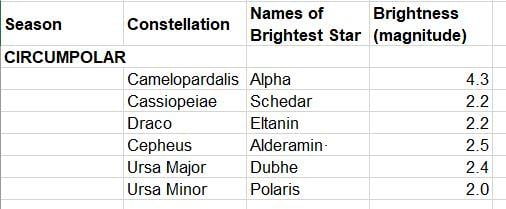
Brightest Stars