
I first met Tara Soloway, founder of Plantd Life, on a warm, sunny day in Toronto last spring. I entered the second-floor studio space where she was hosting a meet-and-greet with excitement and trepidation. In the centre of the room was a long harvest table with individual place settings that included a potted plant, a pair of clippers and a name tag.
I had only just begun my foray into gardening. Sure, I’d dabbled a bit in the dirt, but my husband and I had only just purchased our heritage farmhouse on 3 rural acres a few months earlier. After being a city girl (and when I say that, I mean I spent the first 30 years of my life living in apartments with no yards and the next two decades too busy raising four kids to even consider growing plants!), this was my first summer really trying to turn my black thumb green.
The invitation to meet Soloway said, “Roll up your sleeves for a plant therapy session while you learn more about biophilia and the art of thoughtfully curated interior plant design.”
I’m sorry–bio what? The journalist in me took over and I have since spent numerous hours educating myself about the power of biophilia, the term coined by Dr. Edward Biophilia and the Art of Plants Tara Soloway’s knowledge of different plant species, combined with her creative design aesthetic, makes her a true artist: A blank wall is her canvas and a plant is her medium.
Read on to learn how she is changing the way we see (and feel) home decor.

Wilson, a Harvard naturalist, to describe the human desire to be drawn to nature, and to feel (and crave) all of its goodness. Soloway put this into perspective for me during her event. “Picture walking into a hospital room. Stark walls, colourless and sterile,” she began. “Now, imagine walking into that same space, and there is a giant green leafy plant in the corner of the room.” Around this time, my mother was in a long-term-care facility.
I immediately got her point. Unlike me, Soloway was surrounded by plants her whole life. “I grew up in a home filled with plants,” she says. “My dad had this plant room, and it was like a jungle. He loved taking care of them.” After a successful career in the travel industry with a focus on weddings, her idea to focus on biophilic plant design came during the pandemic. “I had produced a ton of events in the Caribbean, so I gained a lot of experience working with tropical flowers. Since I was no longer travelling I thought, ‘Okay, now what?’ I made a list of things that I loved and plants, gardening and trees were at the top of my list. I started taking online courses, and one was about plant shelf styling from New York Botanical Gardens. That was my eureka moment.”
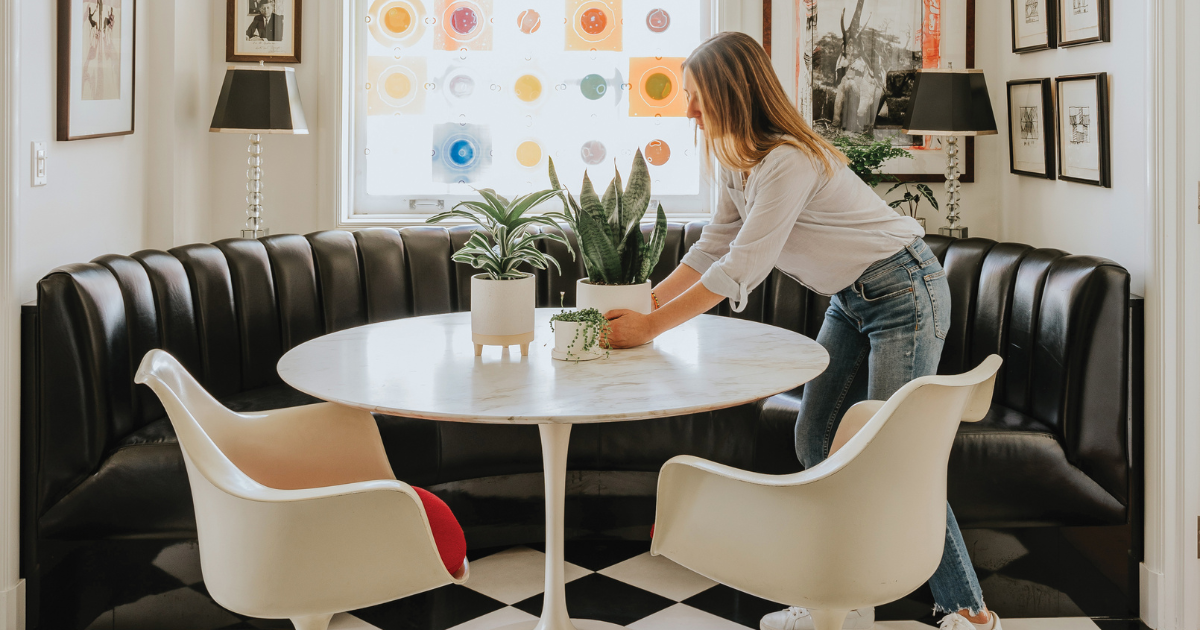
Soloway saw a void in the decor market: She knew some interior designers, but realized they didn’t really know how to incorporate plants into their clients’ homes. “It started with shelves, thanks to that one course. I thought, ‘Instead of putting artwork up on the wall, you could put up some beautiful shelves, especially if it’s near a nice window, and thoughtfully place a
beautiful pot and plant on it and really turn it into something special.’” Her idea was to collaborate with designers (or come up with her own decor theme if a client reached out to her directly, as many do), and help them incorporate plants (and pots) of varying heights and sizes that complement the design aesthetic.
“Usually, you want to stick with plants that require the same kind of light or watering to keep it simple. It’s a fun way of bringing life into your home in a simple, beautiful way..” (The fact that she offers her clients after care–continued maintenance of the plants–is a stress-reliever for some. I suggested some sort of insurance premium for clients like me, but I digress.)
This is where her extensive knowledge of plants plays a key role. Soloway reminded me of the abundant health benefits of indoor plants: Plants convert carbon dioxide to oxygen, which, in turn, helps improve the air quality in our homes and reduce pollutants in the air through photosynthesis; certain plants, like lavender and eucalyptus, are known to aid in sleep; others are
known to potentially help decrease anxiety, act as a sound barrier and increase productivity in the workplace.
Soloway has found great success incorporating her biophilic philosophy into offices, particularly with younger employees. “What usually happens is the employees start to care for the plants. Sometimes, they even start bringing their own plants to their cubicles and when I get there and ask me questions like, ‘What do you think of this?’ or ‘Am I watering it too much?’ It’s that connection, the care and the nurturing, that brings everyone together.”
Soloway believes that the power of plants is so important, she’s started to work with architects and developers before they finish their building designs, so that indoor plants are taken into consideration early in the design and building process. “I think there are some people who are looking to sort of take it to the next level,” she says. “So how do we take that whole biophilic concept and turn the people doing the building into greener builders?”
I have no doubt Soloway will find a way. I was so inspired after speaking with her, I couldn’t wait to share her story. She changed the way I look at plants, not just in my home, but in all the homes I have the pleasure of spending time in. (Don’t worry, friends: I am not judging!) “The concept of biophilia is becoming more prevalent without people even realizing it’s becoming prevalent,” Soloway says. “We have this innate connection to nature. We don’t even realize why we’re so drawn to nature. But it makes us feel better. It makes us feel calmer. It makes us happier. It’s exactly why you go for a walk in the woods or go to the beach and listen to the ocean: You simply feel better.”
So the next time I come to your house, if I am carrying a plant, you’ll know it’s because I really care about you. (Just don’t ask me to care for the plant…yet!)