
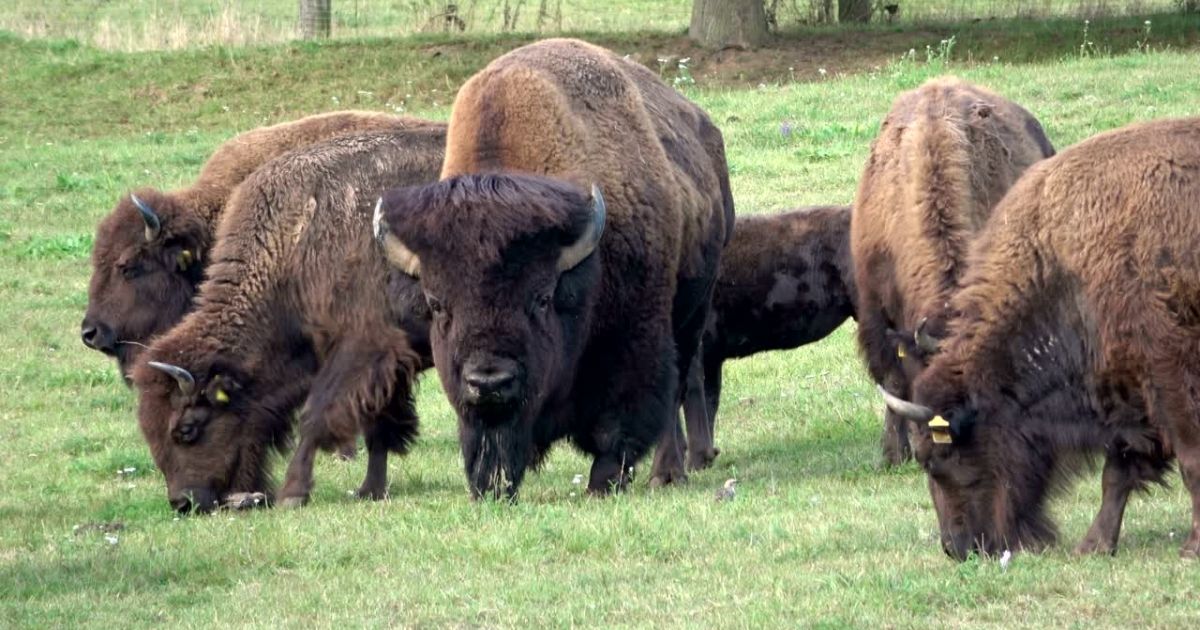
It is hard to imagine that, until the middle of the 19th century, up to 60 million bison roamed across the forests and grasslands of North America. South of the Great Lakes, their range reached all the way to the Appalachians, while in Canada large parts of what would become the Prairie provinces were home to the great northern herds. Early settlers pushed these creatures out of the easternmost limits of their habitat by 1800, and only 30 years later, the assault upon the vast herds of the plains had begun. Within only a few decades, the bison were pushed to the brink of extinction, and by 1888 there were no wild plains bison left anywhere in Canada. Across the continent, there were, at most, only a thousand animals left.
Yet even as the slaughter reached its zenith, there were early calls to tame the surviving bison and turn them
to agricultural purposes. One of the earliest mentions of “buffalo farming” came in a February 1888 editorial featured in several American newspapers that called upon the “cattle kings of the west” to take up bison farming to meet an urgent demand for affordable buffalo robes. A few enterprising farmers did this, and by the 1890s there were a small number of commercial herds in the United States, such as those owned by the Huber brothers in Cochrane, Wisconsin, or C.J. (Buffalo) Jones of Garden City, Kansas.
For the most part, however, bison farming remained relatively uncommon for the next hundred years. It was only in the 1990s that a rising interest in “exotic meats” saw the industry become widely established in Canada. In 1991, for example, there were less than 16,000 bison on Canadian farms.
Five years later, that number had risen to over 45,000, and today there are almost 150,000 bison in Canada. These animals are raised by almost a thousand different producers, large and small.
Farmers, or ranchers (it depends on who you ask and whether they are wearing a baseball cap or a cowboy hat), raise bison from Nova Scotia to British Columbia; although, as one would expect, the largest herds are in Alberta, Saskatchewan and Manitoba. Terry Kremeniuk, executive director of the Canadian Bison Association, credits the highquality protein offered by bison meat as one of the key drivers of the industry. “Bison,” he says, “is a lean, nutrient-dense food that is rich in antioxidants and perfect for people with an active lifestyle.” He also notes that having evolved on the Prairies, bison are well