
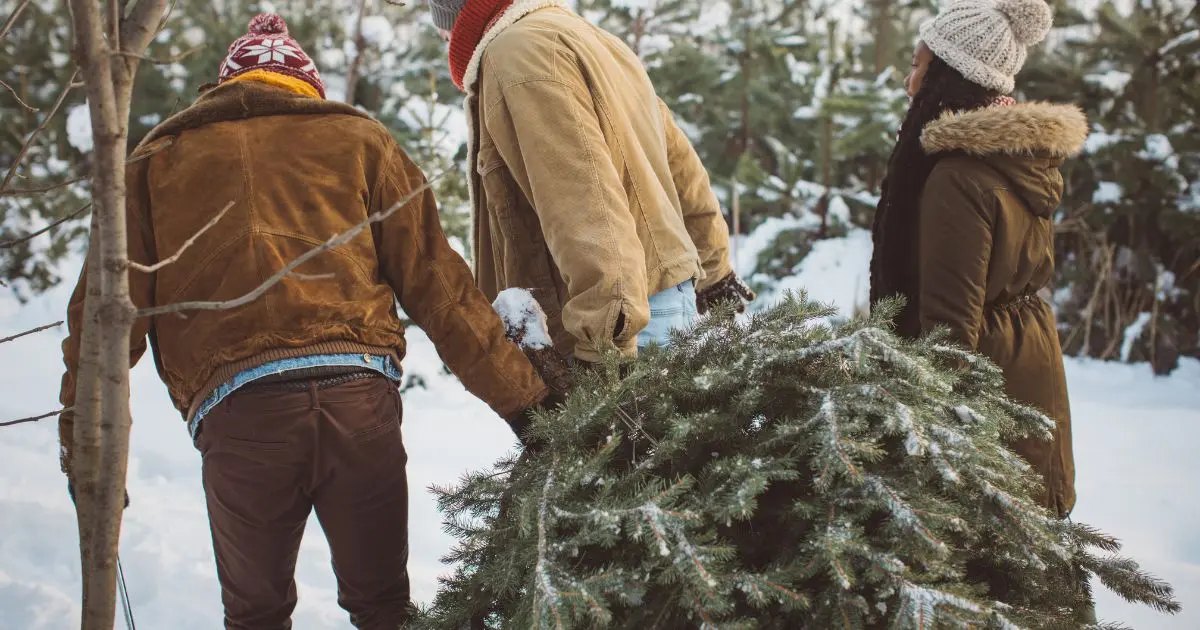
Gardening Editors Ben and Mark Cullen suggest you let your tree stand in your garden after the holidays are over. It can provide smaller animals with shelter, and, “you can even hang suet on it and let the birds forage.”

Regardless of what type of tree you get, dispose of it responsibly: Plant your live tree; if you aren’t going to reuse your artificial
tree, donate it; have your real tree turned into mulch (as many of us in Canada do when we leave our tree for pick up by our local recycling programs).
Get crafty: Use the needles to make scented sachets or evergreen potpourri; the trunk can be cut to make coasters.
Donate it to a local goat farm, as long as it has not been sprayed with harmful pesticides or other chemicals, of course. But please call ahead: Some goat farms get too many donations and may not have a need for yours. (Hopefully they will be able to refer you to another farm.)
By comparison, a two-metre-tall artificial tree is estimated to have an equivalent carbon cost of 40 kilograms, should it be
discarded. In other words, we would have to reuse our artificial Christmas tree for at least 12 years for it to be more eco-friendly than a real Christmas tree.
The Nature Conservancy votes for real trees. “Buying real trees will help keep tree farms in business, and, in turn, keep their lands covered in the healthy forest habitat that wildlife depends on to survive.
When our forests are sustainably managed, they can produce renewable resources like Christmas trees and other wood-made products.” (Visit the Nature Conservancy of Canada at natureconservancy.ca/en.)
In 2018, the CBC published an article that looked at which option was the greener, cleaner way to have a Christmas tree,
and concluded that, “a real tree generates fewer greenhouse gas emissions per Christmas than an artificial one, but that changes if you keep your artificial tree for longer, since the emissions are divided over many years. To minimize the
carbon impact, studies say you should keep the same artificial tree for at least eight years, and preferably more than 20.” They also noted that driving a few hours to cut down a tree (or visiting family and friends, for that matter) had a greater environmental impact than buying a Christmas tree.
Sheridan Nurseries adds: “The cultivation of fresh-cut trees also contributes to soil stabilization and erosion prevention. The trees’ root systems help anchor the soil, preventing runoff and erosion, thus preserving the quality of water bodies and the surrounding environment.”
Rent a Live Tree
While the list is admittedly short, the number of Canadian companies that deliver and pick up living trees appears to be growing:
Alberta
Farlinger Farms
farlingerfarms.com
British Columbia
Evergrow
evergrowchristmastrees.ca
Alive Tree
alivetree.ca
Tristar Nursery Garden Centre & Florist
tristarnurseries.com
Ontario
Sheridan Nurseries
sheridannurseries.com
Note: It’s a good idea to check ahead to confirm that they serve your specific area.